
Process Integrity
Maintain process integrity across complex manufacturing systems
Built for high-stakes process stability, control, and continuous improvement.
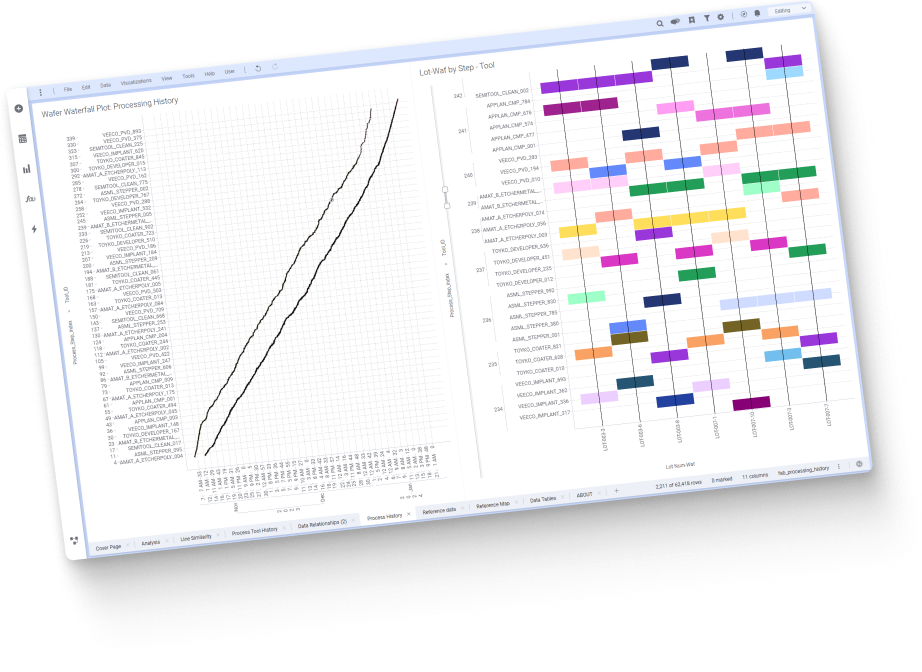
Manufacturing processes are influenced by hundreds of variables across tools, chambers, recipes, and production steps. Maintaining stable, repeatable performance requires understanding how variation emerges, propagates, and impacts output.
Process signals are captured across control systems, metrology tools, inspection platforms, and production data. These perspectives are often analyzed separately, making it difficult to detect subtle drift, understand interactions, and maintain control across the full process.
Spotfire provides a unified industrial analytics environment where engineers can explore process behavior across spatial, temporal, and multivariate dimensions. This enables earlier detection of deviations, deeper understanding of process interactions, and more effective control of manufacturing systems.
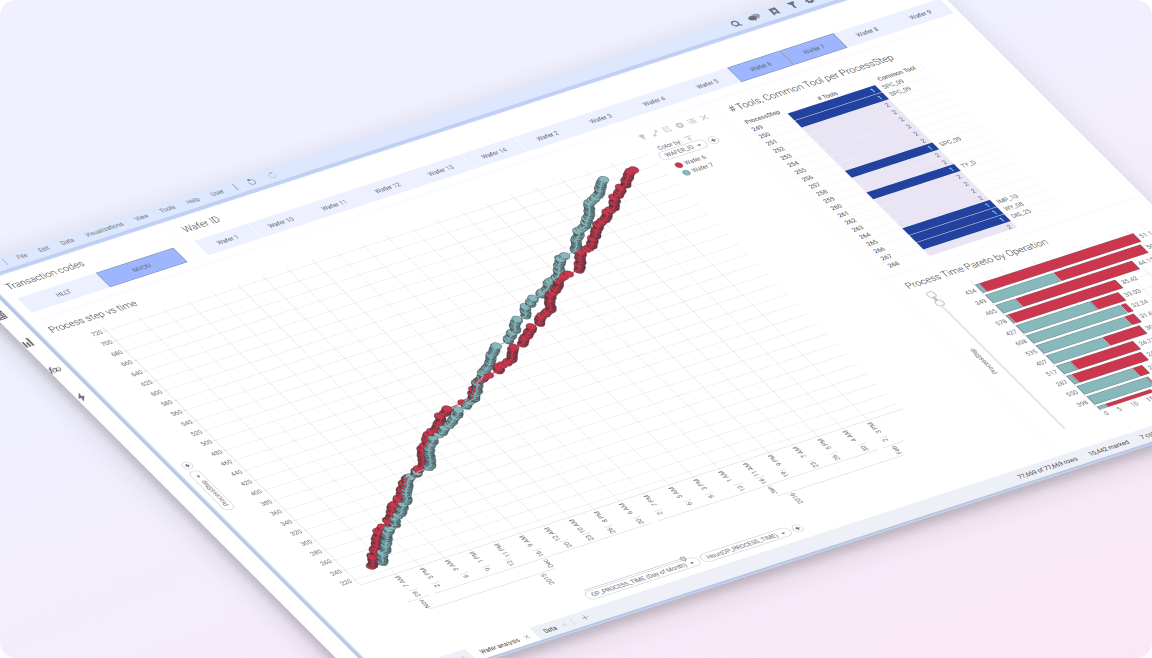
Maintaining optimal process performance requires continuous adjustment based on evolving process conditions and system behavior.
Typical manufacturing scenario
Process parameters are adjusted based on predefined rules or historical trends. However, changing conditions introduce variability that is not fully captured, leading to suboptimal performance or instability.
What changes with a unified environment
Spotfire enables engineers to analyze process behavior in real time, understand relationships between variables, and support advanced control strategies. By combining historical and current data, teams can refine control approaches and improve process stability.
What this looks like in Spotfire
Catching an out-of-control point the moment it happens isn't about watching one trend harder; it's about control limits, spec limits, and the live process signal sharing the same view. Reference Layers in Spotfire support that: control and spec limits sit directly on the process trend, so a deviation is visually obvious the instant it occurs.
Process yield depends on maintaining consistent performance across tools, chambers, and production steps, while minimizing variation that impacts output.
Typical manufacturing scenario
Yield loss is observed, but its origin within the process is unclear. Engineers must investigate across multiple tools and steps to identify where variation is introduced.
What changes with a unified environment
Spotfire enables engineers to analyze yield in the context of process conditions and compare performance across tools, chambers, and lots. This helps identify where variation is introduced and supports targeted process improvements
What this looks like in Spotfire
Finding where yield loss originates depends on consistently comparing performance across lots, tools, and chambers, not on any one rollup calculation. Nested aggregations in Reference Elements hold up their end of that comparison: a yield reference line rolls up correctly across the lot, tool, and chamber hierarchy instead of averaging flatly, so the comparison stays honest at every level.
Scrap events can result from subtle interactions between process parameters, equipment behavior, and environmental conditions.
Typical manufacturing scenario
Scrap rates increase, but root causes are difficult to isolate. Engineers must manually correlate process data, equipment logs, and production events across multiple systems.
What changes with a unified environment
Spotfire brings process data, equipment signals, and production outcomes into a shared analytical context. Engineers can identify patterns, correlate contributing factors, and accelerate root-cause analysis to reduce scrap and improve process reliability.
What this looks like in Spotfire
Correlating scrap events with equipment and production data across systems requires several datasets at once, not a single tool's output. Selecting data from trellis headers in Spotfire plays its role in that effort: clicking a tool or chamber's panel header marks every scrap event for that group at once, instead of a lot-by-lot selection pass.
Understanding how process parameters influence outcomes is essential for optimizing performance and ensuring repeatability.
Typical manufacturing scenario
Engineers analyze process experiments and historical data separately, making it difficult to understand parameter interactions and define optimal operating conditions.
What changes with a unified environment
Spotfire enables engineers to explore process data across multiple variables, identify relationships, and characterize how changes in parameters impact outcomes. This supports more informed decision-making and improved process optimization.
What this looks like in Spotfire
Understanding a new process's behavior means seeing the full shape of its output alongside the experiments and history behind it, not a single average number. Spotfire lets users use violin plots with kernel density estimation, which fill in one part of that picture: the full output distribution becomes visible, catching multimodal or skewed behavior before qualification, right alongside the parameter data driving it.
Process performance often depends on complex interactions between variables that are difficult to identify using traditional analytical approaches.
Typical manufacturing scenario
Design and process interactions are evaluated using limited datasets or isolated analyses, making it difficult to capture the system's full complexity.
What changes with a unified environment
Spotfire enables engineers to analyze multivariate relationships and explore interactions between design and process parameters. This helps identify critical dependencies and supports more robust process design.
What this looks like in Spotfire
Identifying which parameter interactions actually drive variation takes evaluating many variables together, not testing one relationship at a time. Statistical testing functions in Spotfire do their part of that evaluation: built-in ANOVA and variance-comparison tests identify which interactions matter, computed directly in the visualization alongside the rest of the process data.
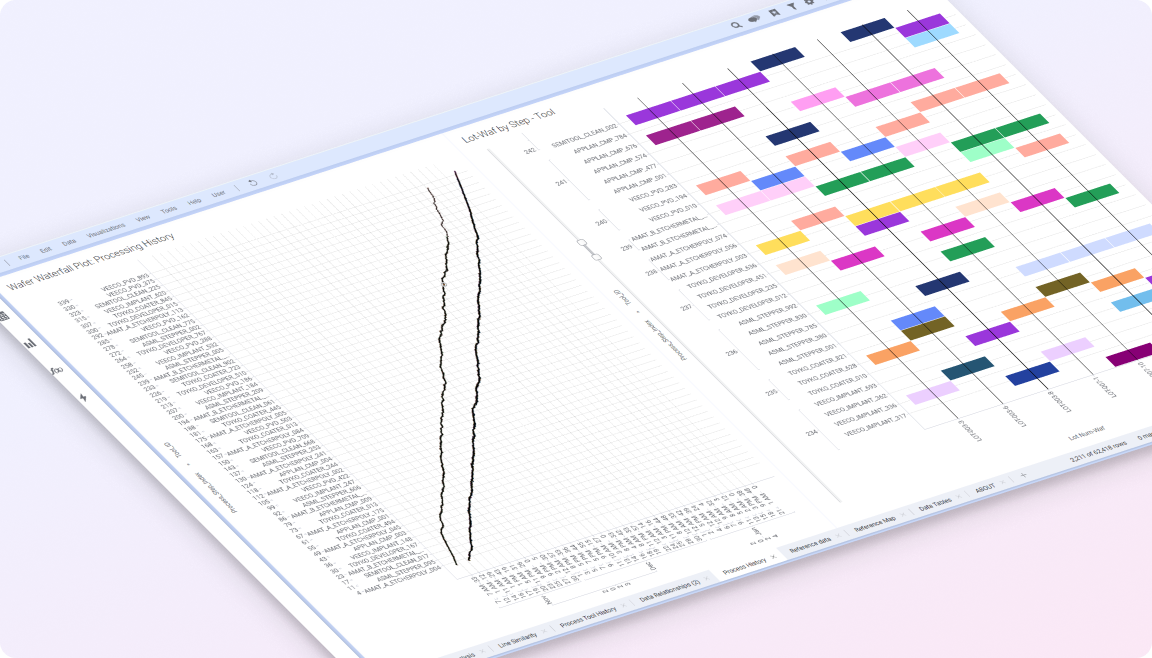
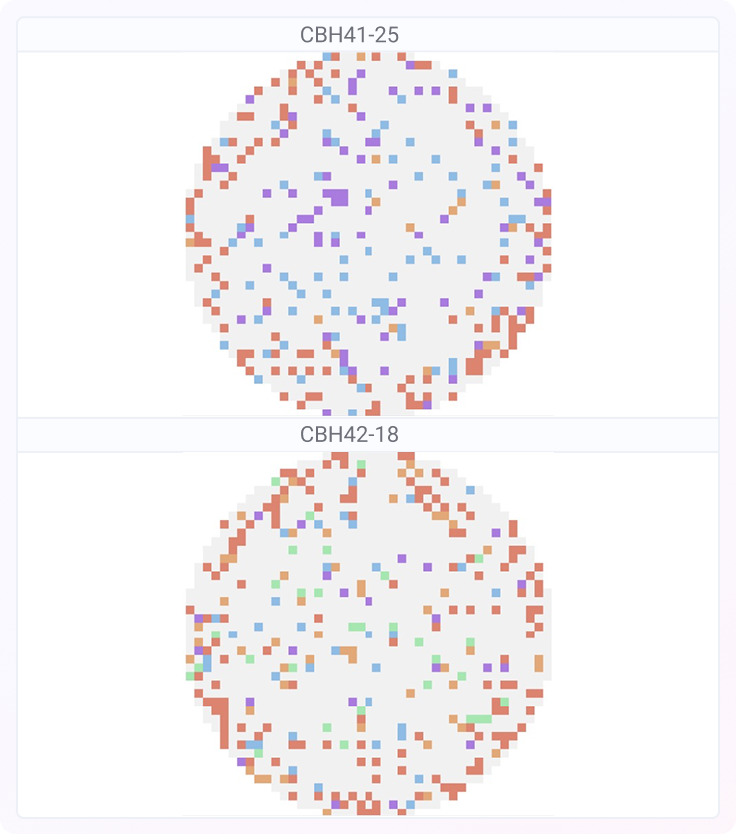
Spotfire builds on the systems manufacturing teams already rely on, bringing process behavior, equipment conditions, and measurement data into a shared analytical context. By enabling engineers to explore variation, detect drift earlier, and understand complex interactions in a single decision layer, Spotfire helps maintain process integrity, improve stability, and drive continuous process improvement at scale.

Detect drift early and keep processes within control
Maintain process integrity across complex manufacturing environments
Learn how leading manufacturers connect data across tools, steps, and systems to understand variability, detect drift earlier, and maintain process integrity, enabling more stable, controlled operations in increasingly complex manufacturing environments.