
Yield Improvement
Improve yield and quality across complex manufacturing systems
Built for high-stakes yield optimization, defect analysis, and quality decisions.
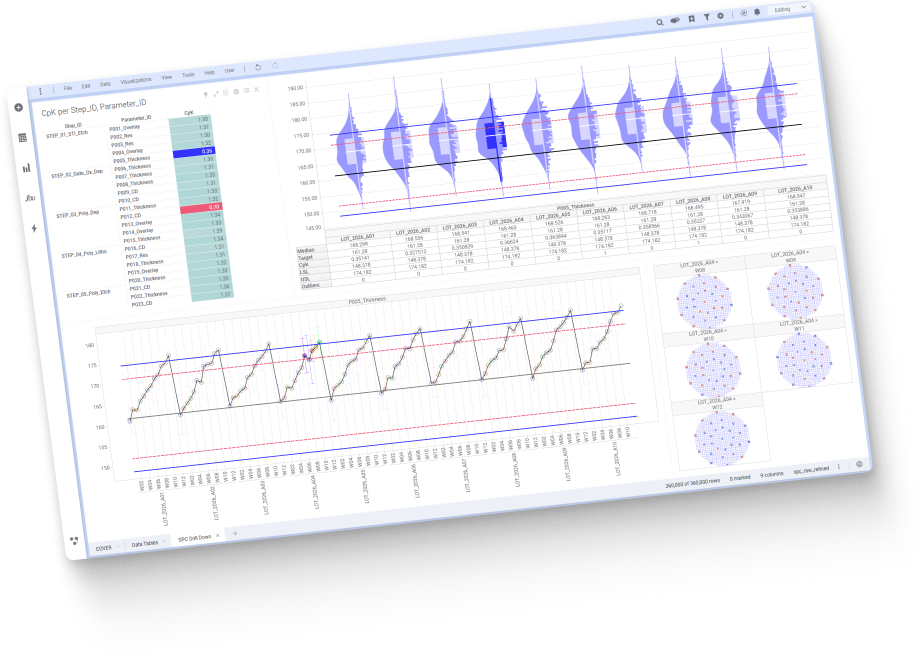
Yield and quality performance depend on understanding how variation propagates across wafers, lots, tools, and process steps. Engineers must correlate signals from inspection systems, metrology tools, wafer sort/probe and parametric test data (WAT/e-test), equipment and MES context, and reliability analysis to identify the drivers of yield loss and product defects.
These perspectives are typically analyzed separately, wafer maps in one tool, test data in another, equipment and MES logs elsewhere, making it difficult to understand how defects originate and how they impact final product performance.
Spotfire provides a shared analytical environment where engineers can explore spatial, parametric, and hierarchical relationships together. This enables faster identification of defect patterns, deeper understanding of yield loss mechanisms, and more effective resolution of quality issues.
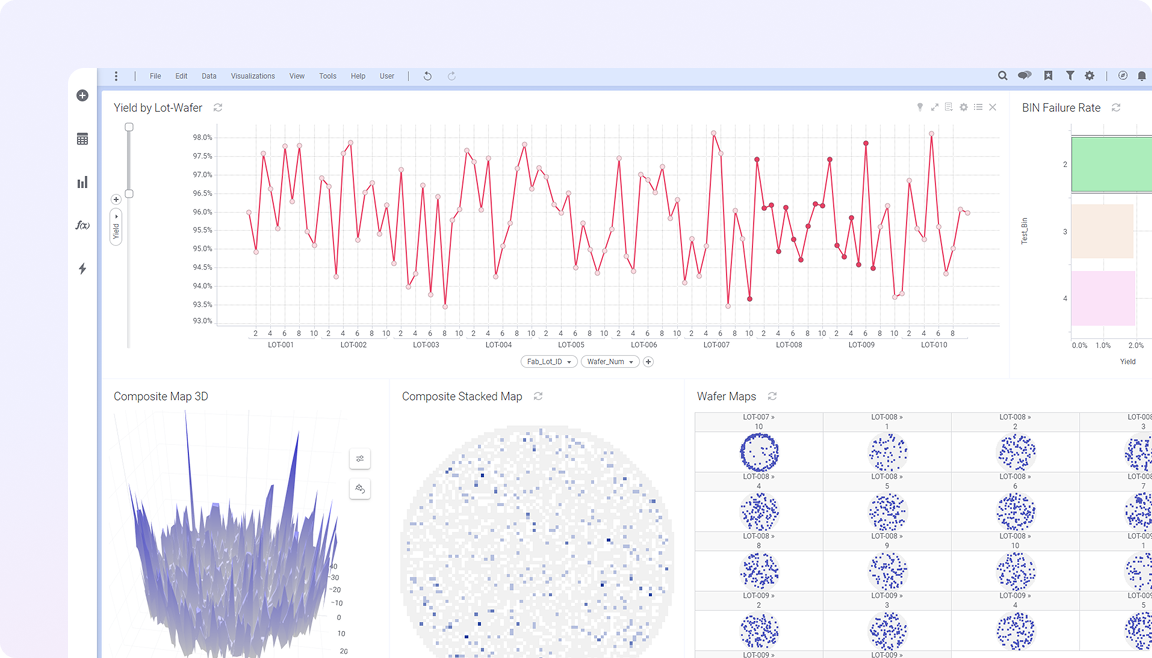
Assembly yield depends on understanding how die-level variation and defect patterns influence downstream performance.
Typical manufacturing scenario
Pick maps and wafer maps are analyzed separately from test results. Engineers can see defect patterns but struggle to understand how they affect assembly yield and final product quality.
What changes with a unified environment
Spotfire enables engineers to visualize wafer maps, pick maps, and test outcomes together in a single analytical view. This allows teams to correlate spatial defect patterns with assembly performance, impacting downstream yield, and optimize picking strategies to improve yield.
What this looks like in Spotfire
Correlating a spatial defect pattern with assembly yield isn't the job of one view; it comes from wafer maps, pick maps, and test outcomes sitting in the same analytical space. In Spotfire, engineers can utilize selections from trellis headers to move faster inside the same analytical environment: selecting every die within a pick-map region takes a single click, not a wafer-by-wafer pass.
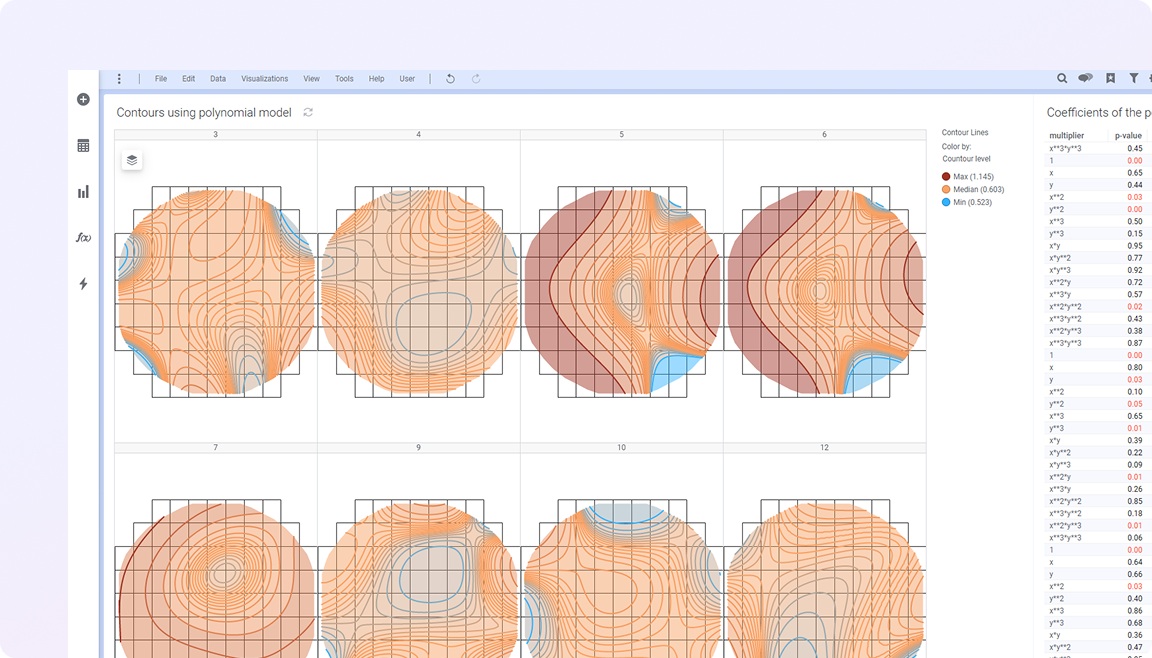
Understanding which defects or test conditions drive yield loss is critical for improving overall manufacturing performance.
Typical manufacturing scenario
Yield loss is observed, but the relative impact of different defect types or failure modes is unclear. Engineers rely on static summaries and manual analysis to estimate yield impact.
What changes with a unified environment
Spotfire enables engineers to analyze kill ratios, correlate defect types with yield outcomes, and rank defect types and test conditions by their measured yield impact. Engineers can compare best- and worst-performing populations to isolate what drives the difference and predict how changes in process or test conditions will affect yield. This supports more targeted improvements and better yield forecasting.
What this looks like in Spotfire
Predicting yield impact, whether by ranking defect types or comparing best and worst performers, doesn't come from one static summary. It comes from kill ratios, defect types, and yield outcomes evaluated in the same place. The Spotfire statistics layer does its part right inside that view: kill ratios and yield-impact metrics calculate directly inside the visualization, so the dominant defect type is visible without a separate summary.
Ensuring long-term product reliability requires understanding how manufacturing variation impacts product performance over time.
Typical manufacturing scenario
Reliability test results are analyzed separately from process and test data, making it difficult to connect early indicators with long-term product behavior.
What changes with a unified environment
Spotfire enables teams to correlate reliability test results with process conditions, defect data, and electrical test outcomes. This helps identify early failure indicators and improve product reliability through more informed decision-making.
What this looks like in Spotfire
Connecting an early signature to a long-term outcome takes more than one dataset; it takes process conditions, defect data, and test outcomes reviewed together. Tooltip support for reference elements in Spotfire closes one gap in that view: hovering a threshold surfaces the linked test values directly, connecting an early signature to a later outcome without cross-referencing separate systems.
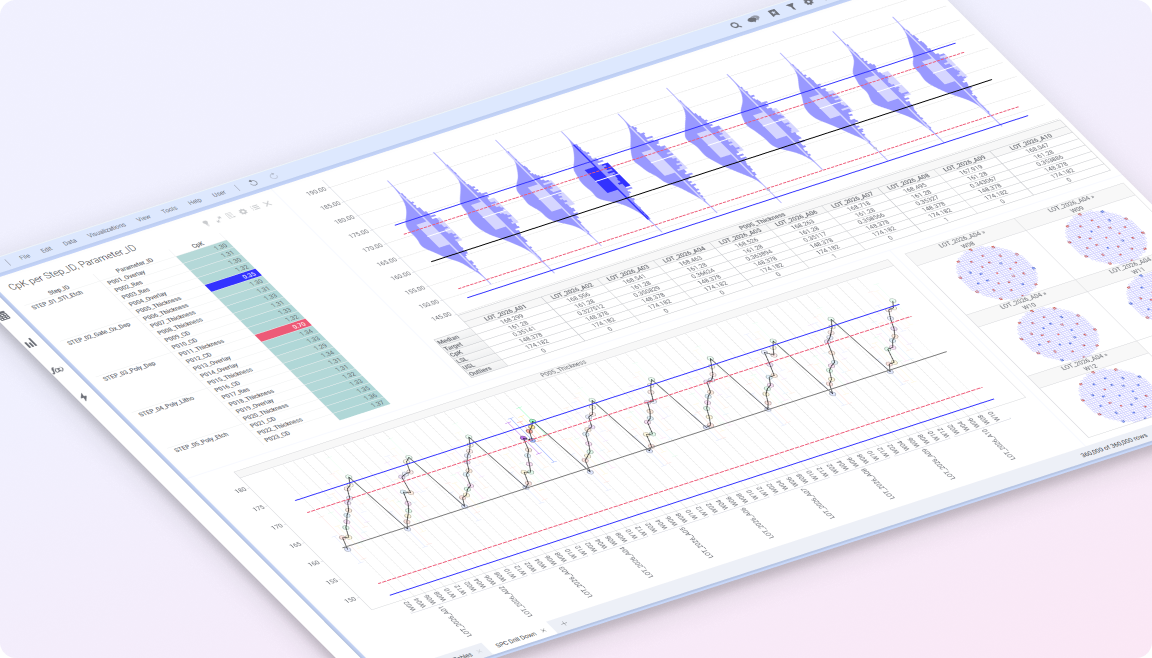
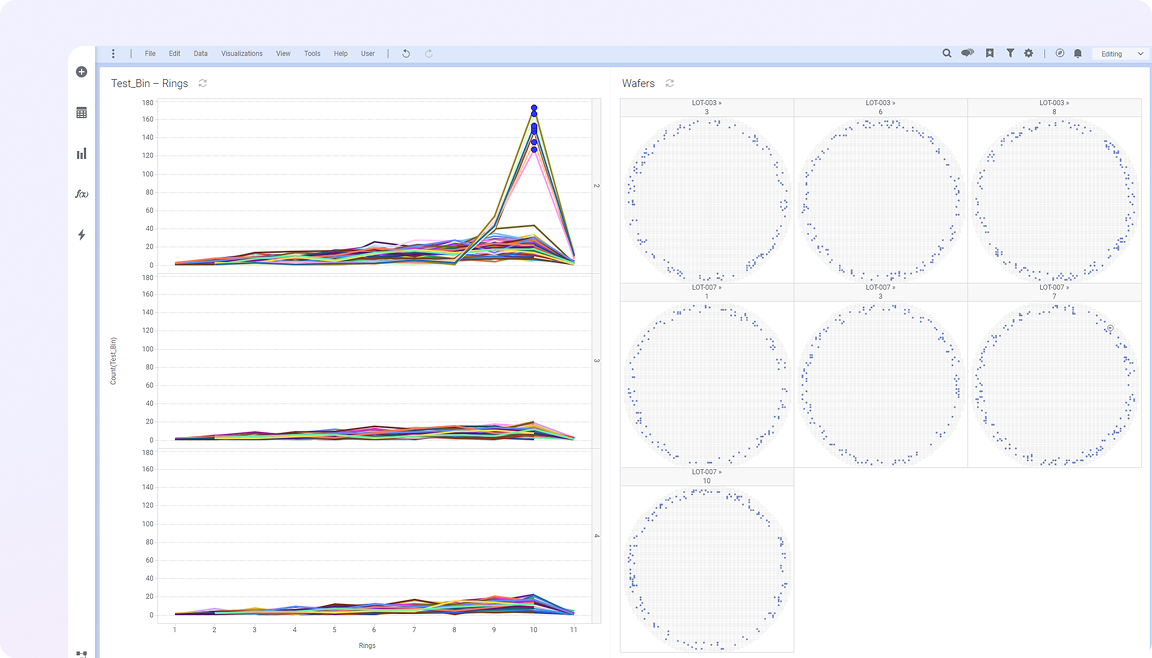
Identifying the root causes of yield loss and product failure requires investigation across multiple datasets and domains.
Typical manufacturing scenario
Failure patterns are identified in test or inspection data, but root causes remain unclear. Engineers must manually correlate data across systems, slowing investigation and delaying resolution.
What changes with a unified environment
Spotfire enables engineers to explore defect data, wafer maps, test results, and process conditions together. This accelerates root-cause analysis, helping teams identify failure drivers faster and implement corrective actions more effectively.
What this looks like in Spotfire
Root-causing yield loss, whether the pattern is categorical or spatial, isn't a one-dataset investigation; it requires exploring defect data, wafer maps, test results, and process conditions together. The Spotfire wafer map visualization removes one manual step from that investigation: die, defect, and metrology layers overlay in a single wafer-aware view, replacing the manual step of lining up three exports by wafer ID.
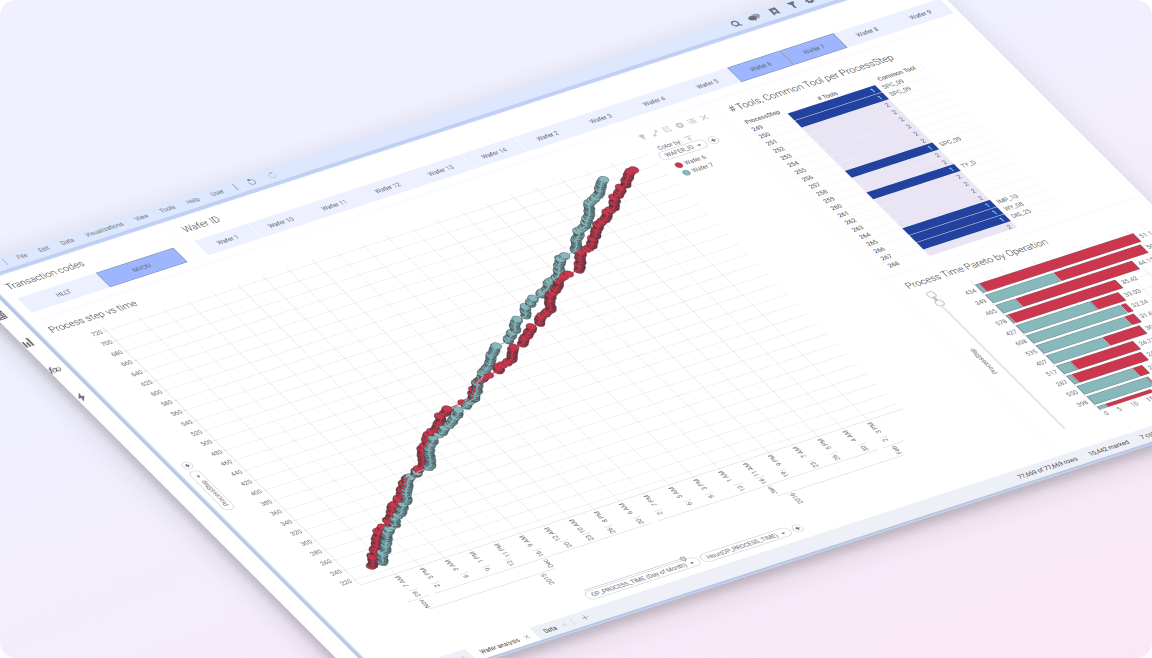
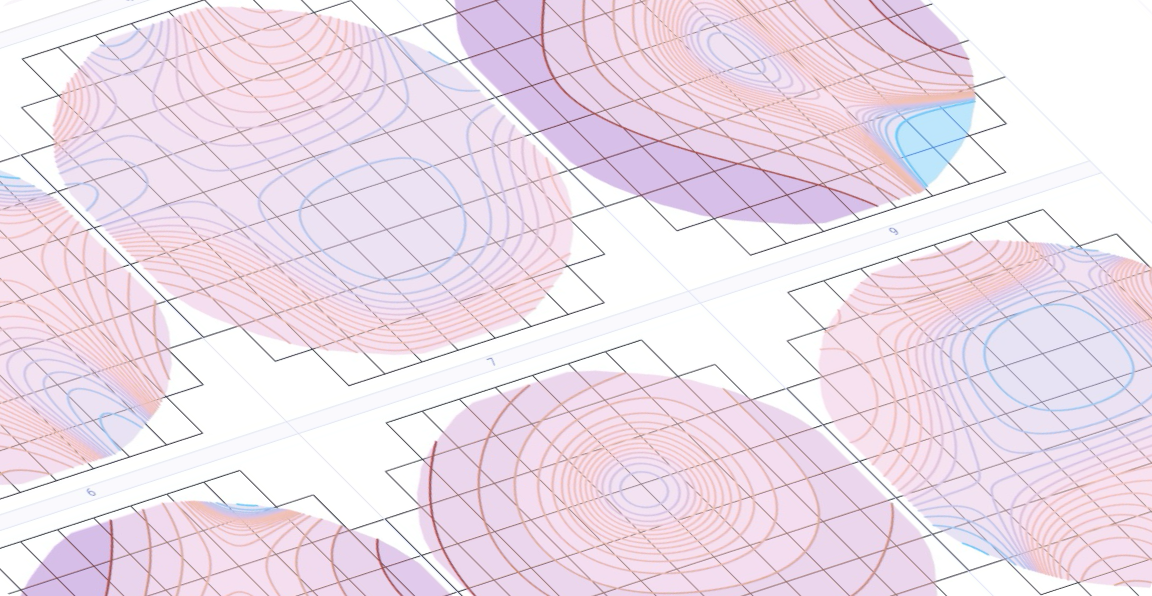
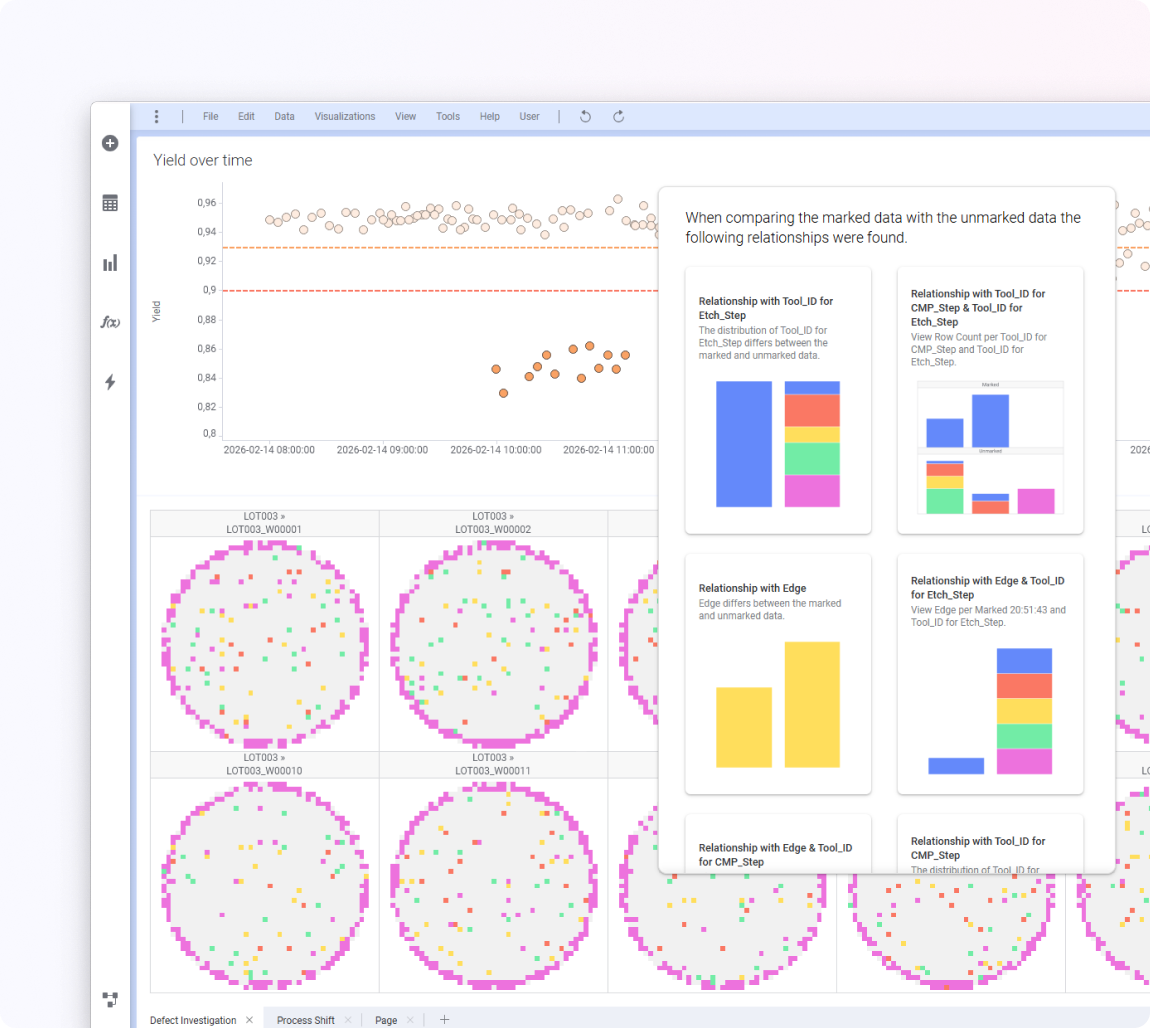
Spotfire builds on the systems manufacturing teams already rely on, bringing inspection data, test results, and process conditions into a shared analytical context. By enabling engineers to explore spatial patterns, correlate yield drivers, and investigate quality issues in a single decision layer, Spotfire helps improve yield, strengthen product quality, and accelerate the resolution of manufacturing challenges at scale.

Surface quality risks faster, with Spotfire
Turn complex manufacturing data into faster yield improvements
Explore how Spotfire Industry Pro enables engineers to analyze data across the production process, detect issues earlier, and pinpoint root causes, helping reduce rework, improve quality, and accelerate time to resolution.