
Asset Valuation
Confident asset valuation in upstream complexity
Understand uncertainty, performance, and economics to guide portfolio decisions.
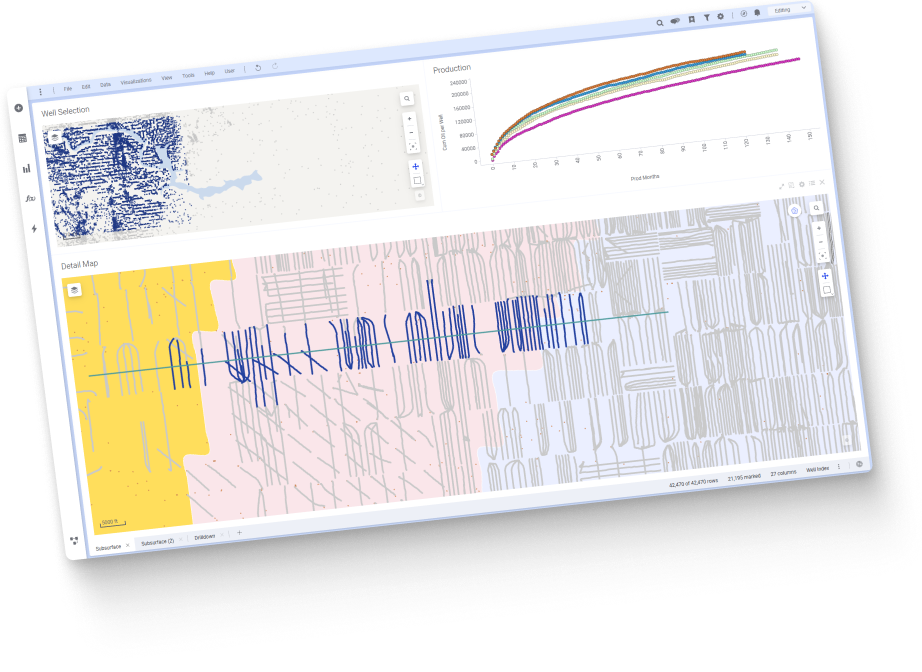
Asset valuation in upstream energy is rarely about a single answer. It’s about deciding where to deploy capital when subsurface uncertainty is high, data quality varies, and outcomes depend on assumptions that span geology, wells, facilities, and economics.
Subsurface interpretation, well spacing, decline behavior, development timing, and price assumptions are often evaluated in isolation, then reconciled late through static summaries and spreadsheets.
Spotfire brings these elements together in one visual environment, helping teams understand how assumptions propagate through the system and where value and risk truly come from. The result is faster alignment, clearer trade-offs, and valuation decisions teams can trust, even when uncertainty is high.
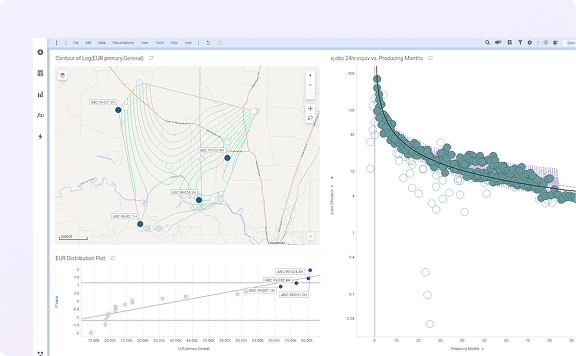
When evaluating A&D opportunities, teams must quickly assess a wide range of assets with varying data quality, uncertainty, and risk profiles. Subsurface interpretation, expected production behavior, development assumptions, and economics are often reviewed separately, which slows comparison and increases the risk of missed insights.
Typical upstream scenario
Teams are evaluating multiple assets with varying levels of subsurface control, analog quality, and development maturity. Type curves, spacing assumptions, and development concepts differ, and small changes materially affect value.
What changes with a unified environment
Spotfire brings subsurface indicators, decline behavior, development scenarios, and economic outcomes into a single visual context. Teams can consistently compare opportunities, visualize uncertainty, and identify value and risk drivers earlier, without manually stitching together models and spreadsheets.
What this looks like in Spotfire
That single view is what makes screening fast, not one feature working alone. In Spotfire, screening thresholds and benchmarks (built with Reference Elements) sit directly on the same comparison as the subsurface, production, and economic signals feeding it, so an opportunity that fails a criterion is visible immediately, in context, not flagged in a separate scorecard disconnected from the data behind it.
Portfolio analysis requires understanding how assets perform relative to one another across different market conditions, development strategies, and risk scenarios. Traditional workflows often rely on static summaries that hide variability and interdependencies.
Typical upstream scenario
Capital is constrained. Development timing, price sensitivity, and risk exposure vary across assets. Portfolio decisions require understanding interactions, not isolated economics.
What changes with a unified environment
Spotfire enables dynamic portfolio views where assets can be compared, filtered, and explored interactively across technical and economic dimensions. Teams can surface portfolio-level risk, test capital allocation scenarios, and align decisions using a shared analytical view rather than static reports.
What this looks like in Spotfire
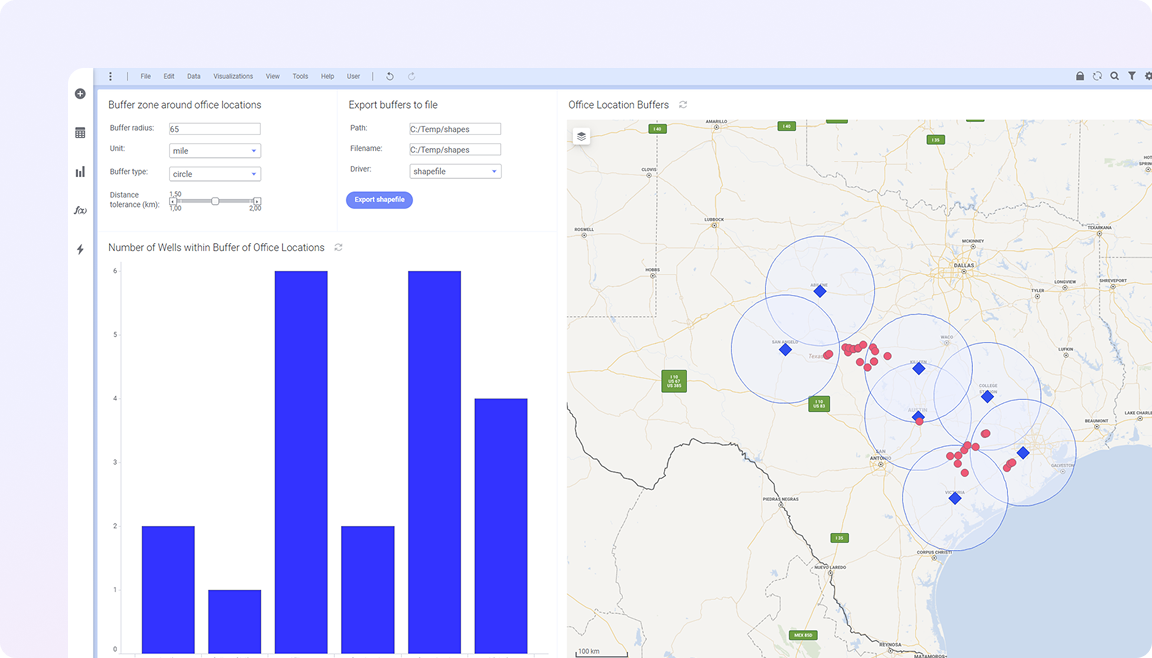
Value comes from comparing assets across every dimension at once, not from any single lens. In Spotfire, multi-layer geospatial mapping adds a spatial view alongside the same financial and performance metrics already in the comparison, surfacing regional patterns a table alone would miss.
Reserves estimation and planning decisions depend on assumptions around recovery, production decline, development timing, and economic cutoffs. When these inputs reside in separate tools, quantifying uncertainty is difficult, and alignment is delayed.
Typical upstream scenario
Reserve estimates are sensitive to assumptions around recovery factors, well performance, spacing, and price decks. Alignment between subsurface teams, reservoir engineers, and planners often comes late.
What changes with a unified environment
Spotfire visually connects reserves assumptions, decline curves, development scenarios, and economic thresholds, enabling teams to explore uncertainty, validate assumptions, and understand sensitivity earlier. This leads to more transparent, defensible, and aligned reserve estimates with planning decisions.
What this looks like in Spotfire
Confidence comes from reserves staying connected to the same assumptions driving the rest of the picture, not from a modeling step run off to the side. In Spotfire, decline curve analysis enables the recalculation of reserves dynamically as data is filtered, so estimates update in step with the subsurface and economic view around them.
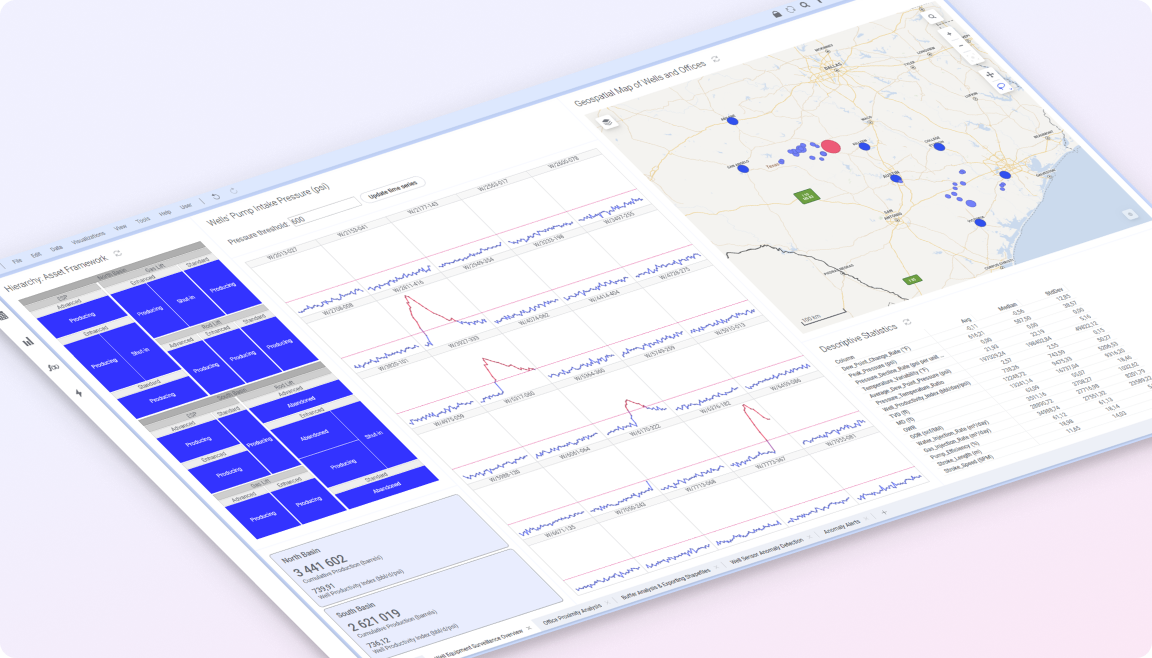
Spotfire doesn’t replace the tools upstream teams rely on. It connects them. By bringing subsurface, production, operational, and economic insights together in a single decision layer, Spotfire helps teams evaluate assets more confidently, surface risks earlier, and make valuation decisions that stand up to scrutiny, even in the face of uncertainty.

From fragmented data to confident asset decisions
Turn subsurface data into AI-driven insight
Spotfire brings subsurface, operational, and economic signals together, enabling teams to assess value, test scenarios, and act with confidence. Explore how upstream teams are rethinking subsurface analytics, using AI to connect data, uncover patterns earlier, and make more confident asset decisions.

intelligence - faster, with Spotfire.