Field Development
Align field development decisions across disciplines
Bring subsurface, design, production, and
economics into one decision layer.
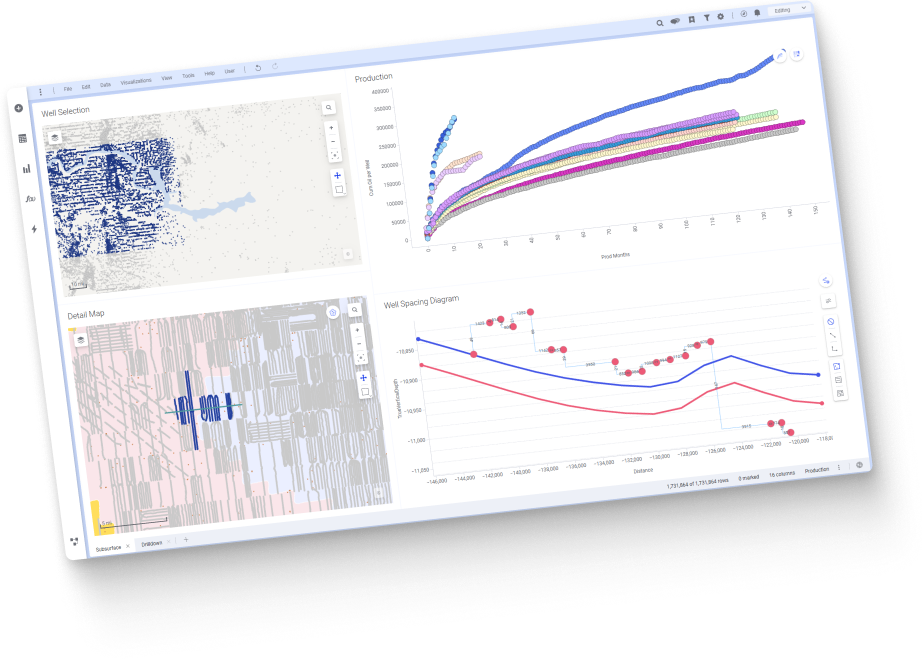
Field development decisions sit at the intersection of uncer-tainty and commitment. Teams must translate subsurface insight into drilling plans, completion design, production expectations, and development schedules, often before performance is known.
Geology, reservoir behavior, well design, and economics are typically evaluated in separate tools, then reconciled late. Small changes in spacing, landing zones, or completions can significantly impact recovery, cost, and value.
Spotfire brings these perspectives together in one visual industrial analytics environment, helping teams understand how decisions propagate from rock to production before plans are locked in.
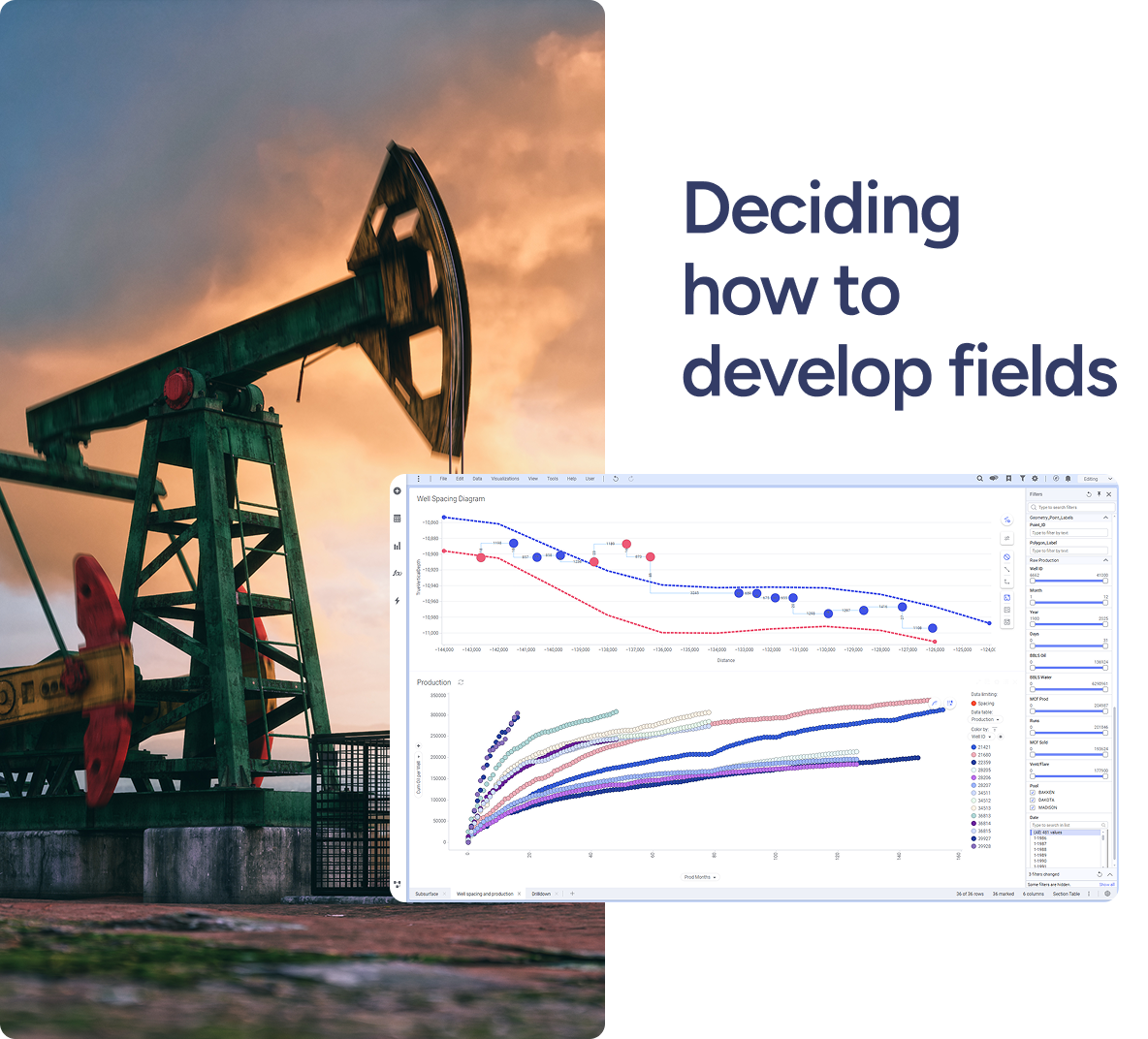
Field development planning requires comparing multiple development concepts under uncertainty, spacing options, phasing strategies, and infrastructure assumptions. Spotfire helps teams explore scenarios side by side, understand trade-offs earlier, and align on development strategies with fewer late-stage surprises.
Typical upstream scenario
Teams must evaluate multiple development concepts with different spacing, phasing, well counts, and infrastructure assumptions. Subsurface uncertainty, drilling risk, completion design, and economics interact, and small changes can materially impact outcomes.
What changes with a unified environment
Spotfire enables teams to explore development scenarios visually, connecting subsurface assumptions, well designs, production forecasts, and economics within a single context. Teams can see how decisions propagate through the system, surface risk earlier, and align on development strategies before plans are finalized.
What this looks like in Spotfire
Value comes from comparing every development concept side by side in the same context, not from any single view. In Spotfire, trellised visualizations put multiple development plans on screen together, alongside the same subsurface and economic assumptions, so teams compare scenarios directly instead of switching between separate models.
Connecting drilling execution to reservoir performance is critical for improving outcomes, yet drilling and subsurface insight often remain disconnected. Spotfire helps teams understand how drilling behavior, well placement, and reservoir response interact across development campaigns.
Typical upstream scenario
Drilling execution generates valuable insight into reservoir behavior, pressure, and rock properties, but that information is often underutilized beyond individual wells.
What changes with a unified environment
Spotfire connects drilling data, well placement, pressure behavior, and early production response, enabling teams to understand how execution impacts reservoir performance. This supports faster learning across wells and continuous improvement throughout the development program.
What this looks like in Spotfire
Value comes from keeping execution data and reservoir behavior in the same view, not from any one data source. In Spotfire, direct LAS and WITSML file import brings well log and drilling data in without manual reformatting, so geology and drilling results tie back to the reservoir model alongside the other execution and performance signals already there, faster, and without a separate data-prep step breaking the connection.
Completion design decisions directly influence recovery, cost, and long-term performance, but design choices are often evaluated in isolation. Spotfire helps teams connect completion parameters to reservoir response, production behavior, and economics to optimize designs with confidence.
Typical upstream scenario
Completion designs are tested across wells, often with limited ability to compare outcomes consistently. Variability in rock properties, pressure, and execution complicates optimization.
What changes with a unified environment
Spotfire enables teams to compare completion designs across wells and development areas, linking design parameters to reservoir response, production performance, and economic outcomes. Teams can identify what works, and why, earlier in the development lifecycle.
What this looks like in Spotfire
Confidence comes from testing completion parameters against the same production and economic context every time, not from a model run on the side. In Spotfire, built-in statistical and ML data functions compare completion designs directly against production outcomes already in view, surfacing which variables actually drive performance.
Field development depends on understanding heterogeneity, uncertainty, and connectivity across the reservoir. Spotfire helps teams integrate seismic, logs, core, and well data to build a shared understanding that informs development decisions.
Typical upstream scenario
Reservoir heterogeneity, uncertainty, and connectivity directly influence well placement, spacing, and development outcomes. Data lives across seismic interpretation, logs, core, tests, and production history.
What changes with a unified environment
Spotfire brings seismic attributes, logs, core data, tests, and production behavior together visually, enabling teams to understand variability, validate assumptions, and inform development decisions with greater confidence.
What this looks like in Spotfire
That shared understanding comes from seeing seismic, log, and core data together in one context, not from any single chart. In Spotfire, vertical-orientation line and combination charts display log and core data depth-first, the way geoscientists read it, alongside other reservoir data in the same view, with nothing reformatted to fit a horizontal layout.
system-level understanding
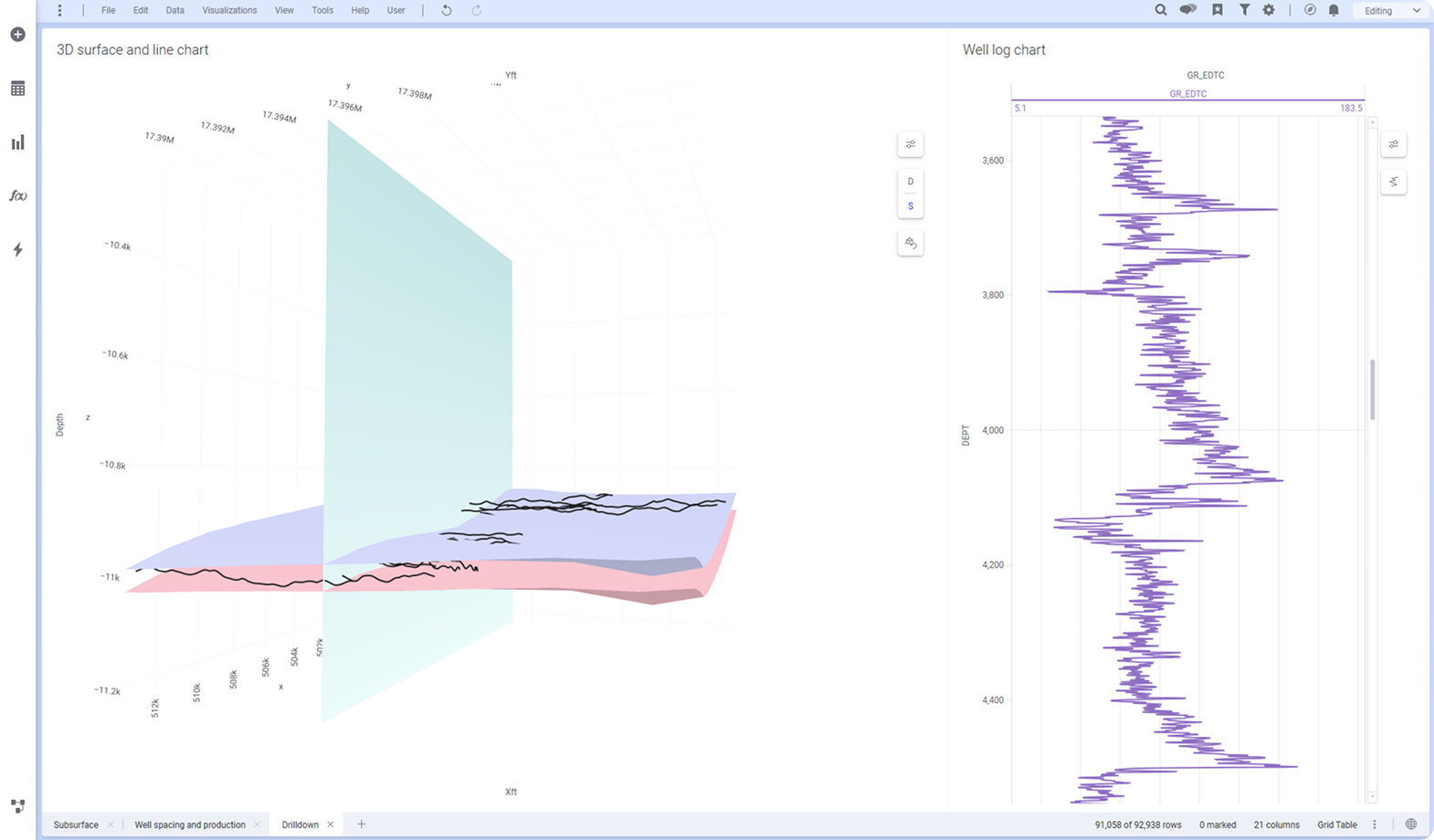
Spotfire doesn’t replace the tools upstream teams rely on to design and execute wells. It connects them. By unifying subsurface insight, drilling and completion design, production behavior, and economics in one decision layer, Spotfire helps teams reduce uncertainty, improve consistency, and make field development decisions that stand up over the life of the asset.

Spotfire helps teams reduce uncertainty
Accelerate field development with connected insight at scale
Learn how Spotfire Industry Pro, combined with Snowflake, enables teams to unify subsurface, drilling, and production data, accelerating scenario analysis, improving planning, and supporting more confident field development decisions.