
Spotfire® and AI
AI-augmented industrial investigation
The greatest value of AI in complex industrial environments comes from combining AI with human expertise, helping experts understand complex systems, investigate uncertainty, and make confident decisions faster, grounded in investigations they can reproduce and defend.
Industrial organizations operate in environments where decisions depend on understanding relationships across systems, processes, time, and changing operational conditions. Engineers and analysts investigate these relationships iteratively, exploring deviations, comparing perspectives, testing hypotheses, and validating findings to understand not only what happened, but why.
This is where Spotfire’s approach to AI differs fundamentally. Our approach is industry-native AI: AI aware of industrial data structures and domain workflows. It works on assembled spatial, temporal, and hierarchical data and keeps every finding tied to the evidence behind it, bringing intelligence across visual industrial analytics; from conversational investigation to agentic analysis and intelligent workflows, so AI works with the expertise and context that make industrial decisions defensible.
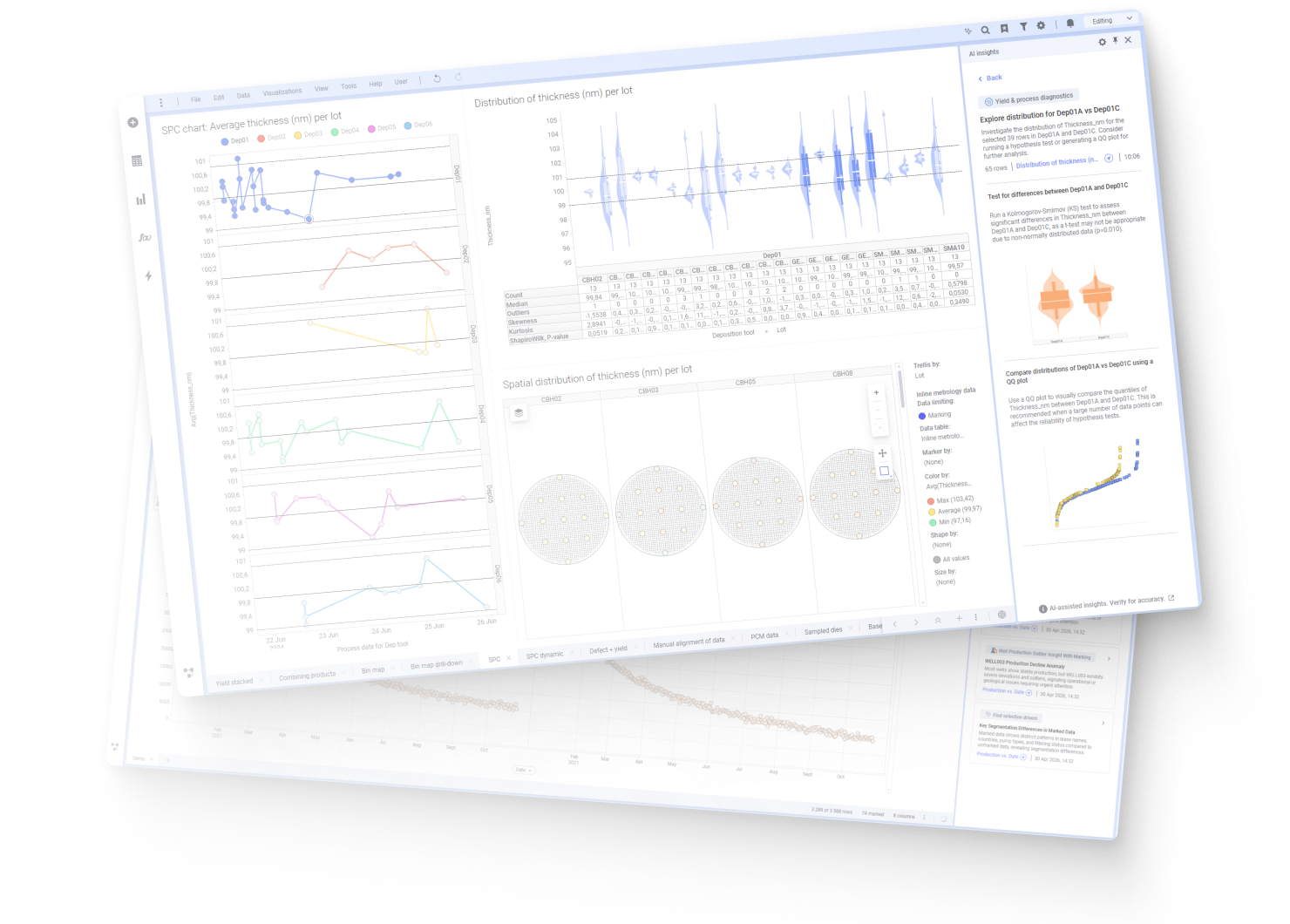
AI in context
Understanding a yield excursion, production issue, equipment deviation, or process instability requires process history, spatial relationships, operating conditions, equipment state, and domain knowledge to establish what changed, why it changed, and what to investigate next.
Spotfire brings the power of AI into this rich analytical context, combining operational and engineering data, industry-specific workflows, visual investigation, and human expertise within a governed analytical environment. By bringing AI and industrial context together, Spotfire helps experts identify patterns earlier, accelerate investigation, reduce repetitive analytical work, and make higher-confidence decisions across complex engineering and scientific environments.
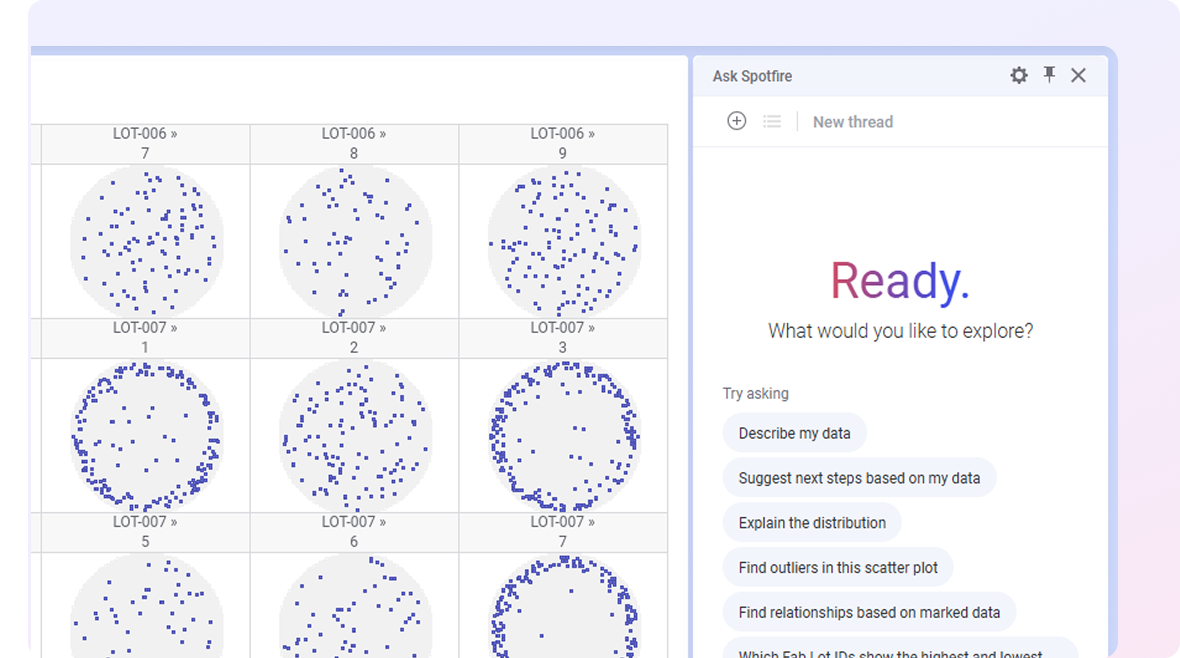
From deviation to defensible cause, without leaving the analysis
Get from a deviation to a cause you can defend without leaving the analysis. Spotfire AI works inside the investigation itself, helping experts move from observation to hypothesis, exploration, validation, and understanding.
It detects deviations, surfaces relationships, recommends the next investigation path, and suggests contextual visualizations, supporting yield excursions, process drift, and equipment behavior in high-tech manufacturing, and well production and asset and field development in energy. Experts explore findings visually and test potential causes against the underlying data, so speed never separates AI-generated insight from the evidence. With AI-augmented data preparation, this allow experts to spend time on what matters and not focus on repititive cleanup tasks.
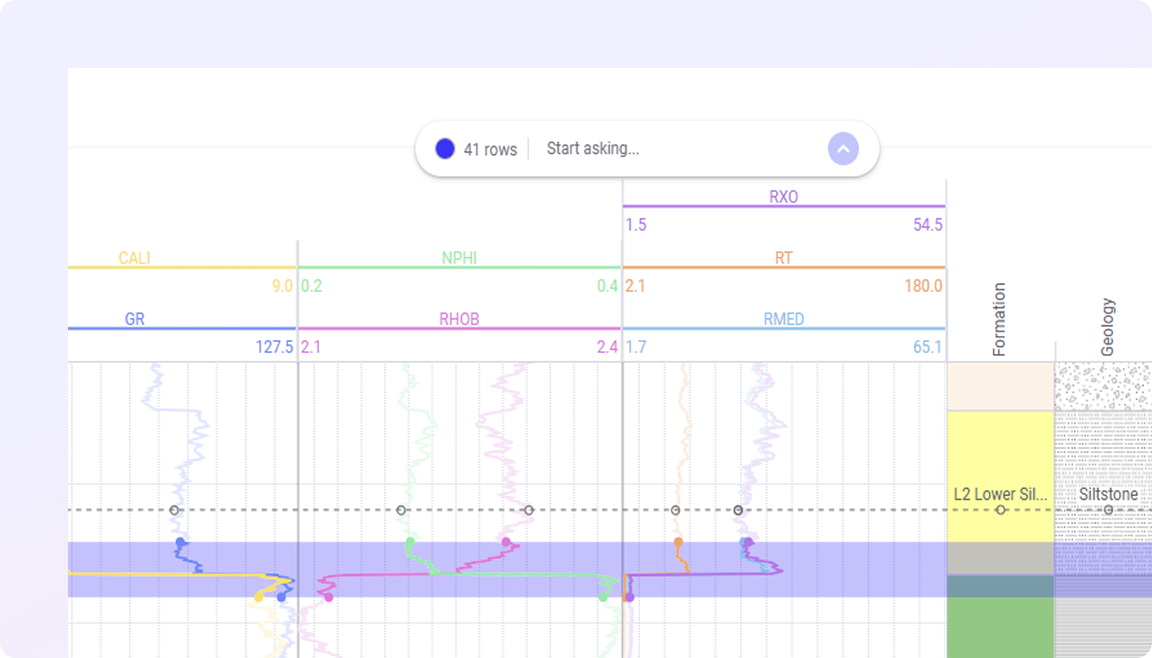
AI you can investigate and trust
Confident industrial decisions depend on understanding the evidence behind them. Spotfire keeps AI-generated findings connected to the underlying data, visual context, and analytical workflow so experts can investigate, validate, and refine conclusions interactively.
Spotfire also supports customer-controlled AI environments, giving organizations the flexibility to bring AI into existing enterprise architectures and governance models while maintaining transparency, traceability, and reproducible, auditable investigations, with security, observability, and operational oversight.
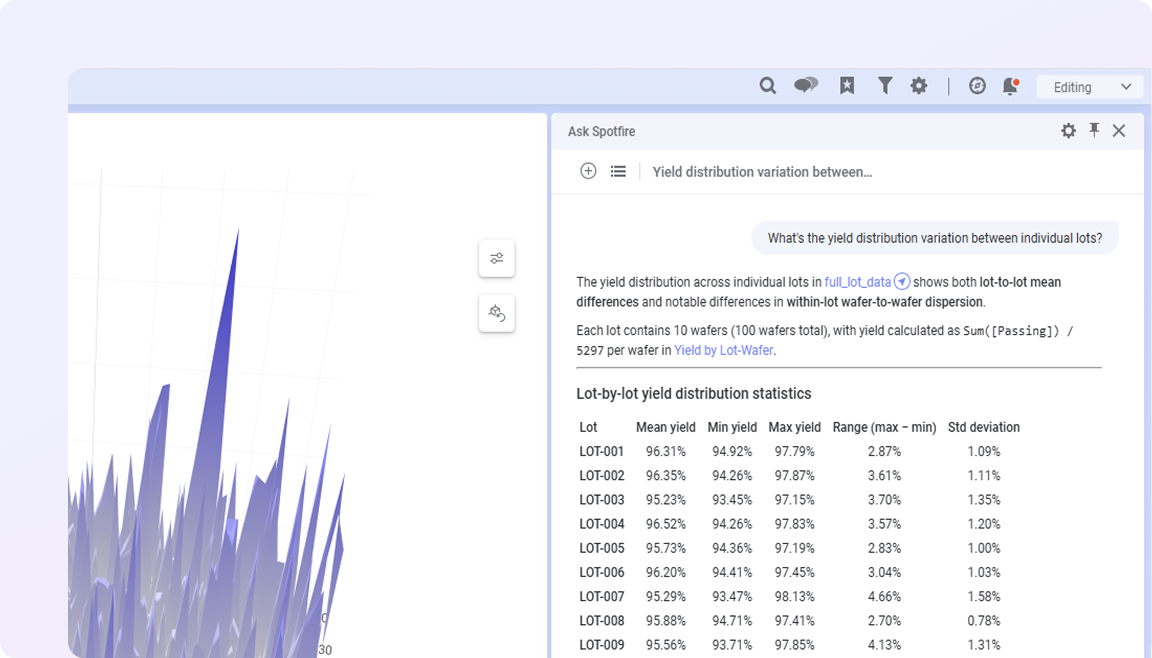
One Spotfire AI: investigate in conversation, powered by agents
Ask a question in plain language and get an answer you can check. Spotfire AI is built into the platform, so experts investigate in the same place they analyze: asking questions, exploring the results, and getting guidance on the next step, while Insight Agents do the analytical work behind each answer. It all runs on one governed foundation, with the same data, context, and controls, so every finding can be traced back to its source and experts can focus on interpretation, validation, and decisions. Organizations can extend it with industry-native custom agents shaped around their own engineering and operational workflows, combining AI with proprietary knowledge, domain context, and specialized analytical methods.
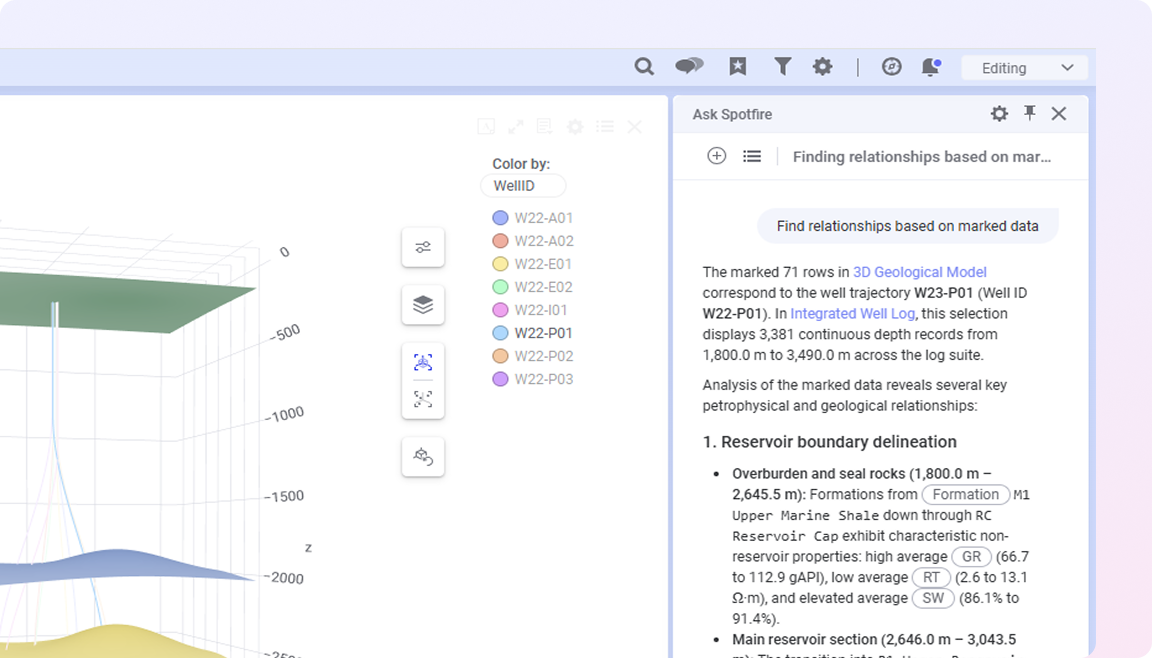
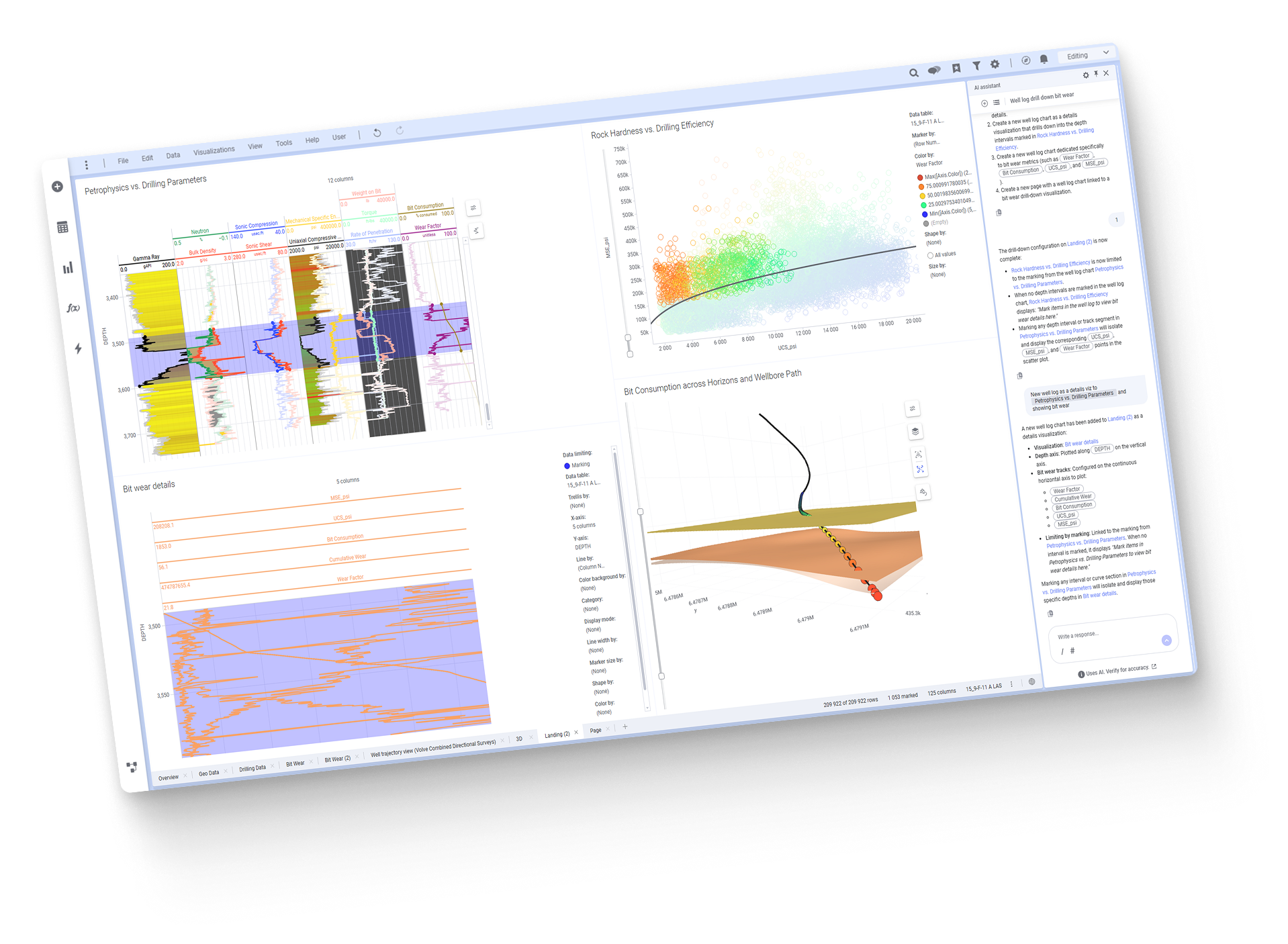
Ask, Augment, Act with Spotfire AI
Generating analysis has never been easier, but trusting it is another matter. This quarter’s update shows how Spotfire AI works inside the analysis, so results stay visible and open to challenge, and teams can go from a question to a defensible decision faster. Explore Ask Spotfire, Insight Agents, and Skills, and watch the on-demand webinar
Spotfire is uniquely positioned to bring AI to complex engineering and scientific problem-solving because AI builds on an analytical environment already designed for investigation.
Multi-domain investigation brings operational, engineering, scientific, and business perspectives together. Visual, statistical, and time-series analytics help experts explore deviations, test hypotheses, and investigate potential causes. Real-time and historical context connects what is happening now with what happened before. And scalable industrial data handling enables investigation across complex, high-volume data without breaking the analytical workflow.
AI amplifies these capabilities, helping experts navigate complexity, accelerate investigation, and uncover insights faster while keeping analysis interactive, contextual, and grounded in evidence.
AI doesn't replace what makes Spotfire powerful. It amplifies it.
Advancing industrial intelligence
As industrial systems become increasingly connected and operational complexity grows, organizations need faster ways to investigate deviations, validate findings, and make confident operational decisions. They need intelligence embedded directly into how decisions are explored, validated, and operationalized.
Spotfire approaches AI by bringing visual analytics, domain expertise, operational context, and governed intelligence together into a unified analytical environment designed for industrial investigation and decision-making.
The result is AI designed not just to generate outputs, but to help industrial teams discover insights, surface risks early, and drive operations forward.