
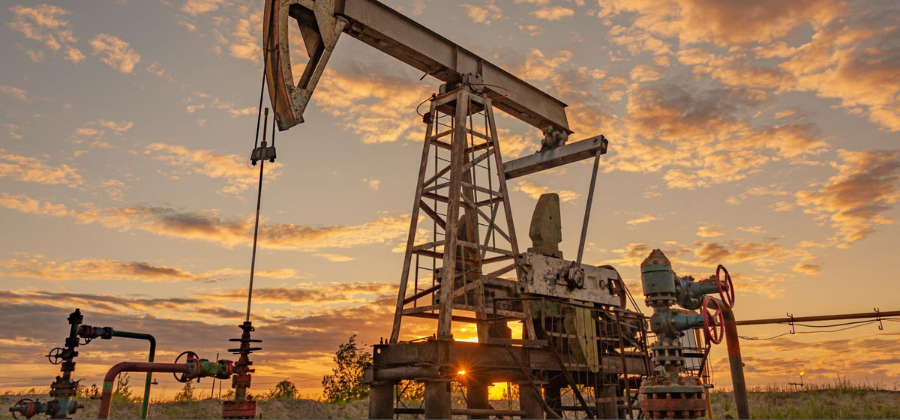
Visual industrial analytics is quietly rewriting the rules of petrophysical decision-making.
When was the last time a paper well log changed a decision in your organization (in real time)?
If you’re being honest, the answer is probably “never.” Across the upstream industry, petrophysicists and geoscientists still spend a huge amount of time wrestling with static visualizations, manually configuring multi-track displays, or waiting for specialist engineers to prepare log views before an interpretation meeting can even begin. In a sector where a single well can cost tens of millions of dollars, we are routinely making billion-dollar basin decisions on the basis of slow, inflexible data workflows built for a previous era.
That era is over. Or at least, it should be.
The real problem is not the data, it’s the setup
Every petrophysicist knows this routine. You load a LAS file. You spend twenty minutes building the display from scratch. You debate gamma ray scales. By the time the log is ready to interpret, half the team has lost focus.
The time lost is frustrating. But the higher cost is harder to see: When experts are forced to act as data formatters, they stop doing the work only they can do. Interpretation slows down. Insight gets delayed. And in a business where decisions are expensive, delays have a real price.
Automation that thinks like a petrophysicist
Well log visualization should be the starting point of every upstream analysis, not the finish line.
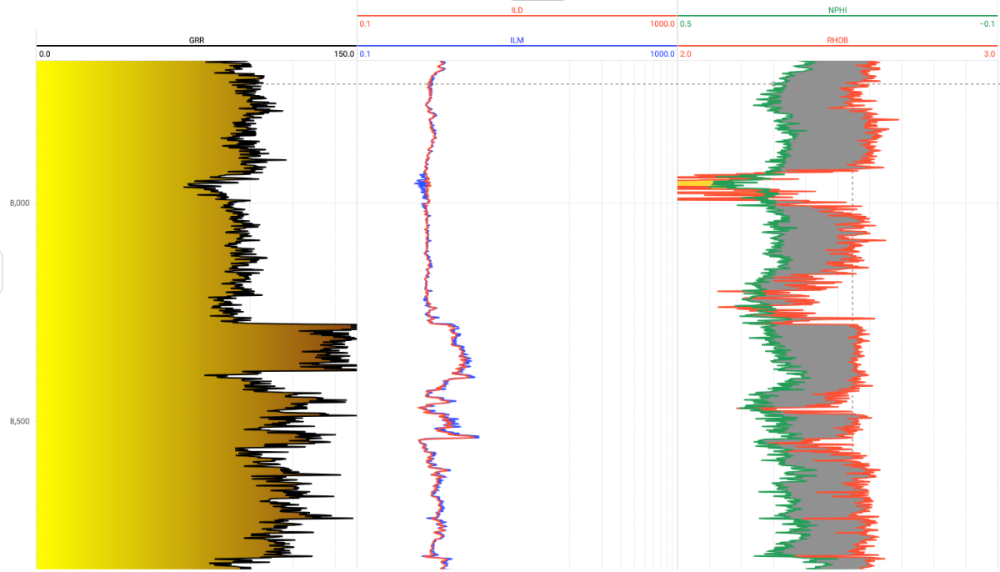
Fig. 1 Formatted multi-track well log visualizations from LAS data.
Spotfire supports the concept of Mods: Purpose-built extensions that add industry-specific capabilities directly inside the analytics platform. The Well Log Mod supports and automates the creation of common multi-track well log displays: the kind that petrophysicists have been building manually for decades. What makes them powerful is the intelligent, data-driven curve detection baked into the workflow. The platform recognizes LAS file structures, applies appropriate formatting conventions, and delivers a display that is ready for interpretation, not preparation. Gamma ray, resistivity, porosity, lithology tracks: all configured correctly, immediately, every time.
This matters more than it sounds. When a senior petrophysicist opens a dataset, their first interaction should be with the geology, not with a settings panel.
From visualization to speed
The upstream industry talks constantly about digital transformation, but transformation is rarely a single technology moment; it is an accumulation of frictionless workflows. When the Well Log is paired with Spotfire’s petrophysics calculator capabilities, shale volume, porosity, and total organic carbon are directly within the analytical environment. The vision becomes clearer: A seamlessly integrated workspace where the distance between raw well data and actionable formation evaluation is measured in minutes, not days.
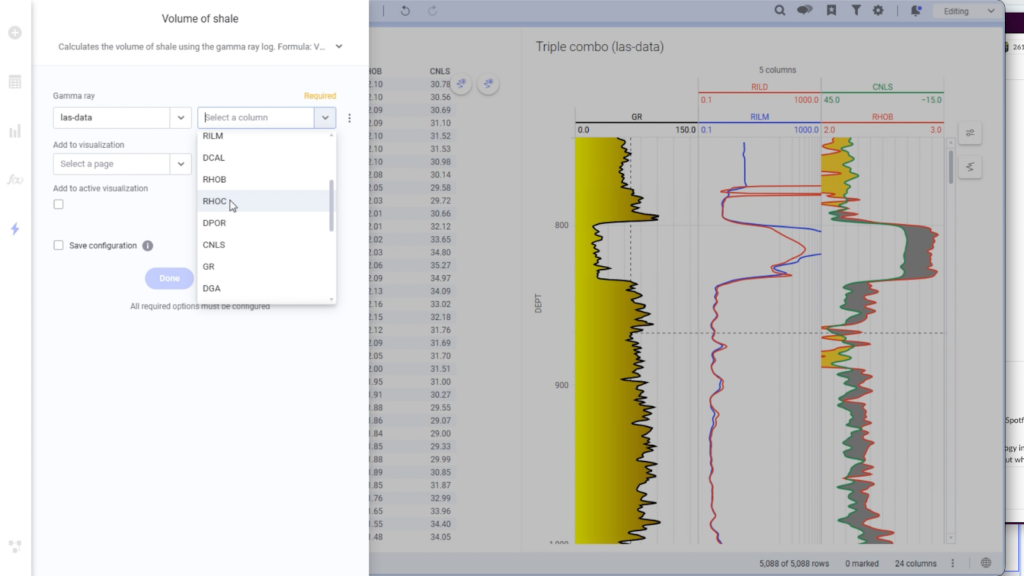
Fig. 2 The petrophysics calculator
For multi-well campaigns and fast-paced development decisions, speed is not a luxury. It is a competitive necessity. Companies that can iterate on subsurface interpretation faster will drill better wells, allocate capital more efficiently, and reduce the interpretation risk that silently inflates dry-hole rates.
The bigger question
For decades, the industry has accepted a quiet tax on its best people. Every time a geoscientist reformats a display, every time a petrophysicist rebuilds a track layout they have built a hundred times before, every time an engineer waits for a specialist to prepare a visualization before a decision can be made, that is expertise being consumed by process. In short, talent is used as a workaround.
The question that industrial-specific analytics tools force us to ask is something harder: How much of what we call “process” in our subsurface workflows is actually just friction we have learned to live with? How many steps in our subsurface analysis exist not because they add value, but because the tools never automated them?
The upstream industry has invested heavily in data infrastructure, cloud storage, data lakes, and digital twins. But data infrastructure without intelligent, domain-specific tooling is like building a motorway with no vehicles. The last mile between the data and the decision still depends on experts manually bridging the gap.
Industry-specific visualizations, like the Well Log Mod, are the beginning of an answer—not because they replace expertise, but because they redirect it. By automating the routine, we free up experts to focus on the exceptional. In upstream operations, this means giving full attention to subtle gas crossover, unexpected porosity zones, and critical anomalies that truly change the drilling plan and create value.