
In oil and gas, complexity isn’t a side effect of the work.
It is the work.
From subsurface interpretation to drilling execution and production optimization, engineering decisions rarely live in one dataset, one model, or even one discipline. Instead, they sit at the intersection of geology, petrophysics, drilling, reservoir, and production, each with its own tools, data formats, and analytical conventions.
Energy teams don’t lack data or expertise.
What they often lack is a clear path from analysis to confident decision-making.
The hidden cost of specialist tools
Specialist tools are essential in the energy industry. Every discipline depends on them to perform both routine analysis and deep technical work. Over time, however, this strength has created an unintended consequence: analytical silos.
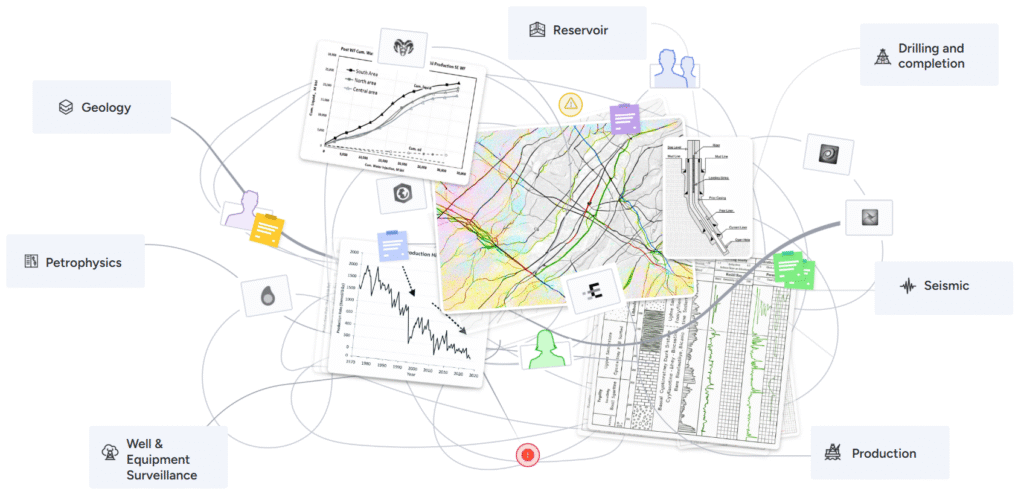
Each team works within its own environment, using its own data structures and workflows. Collaboration happens through screenshots, exports, slide decks, and follow-up meetings. When a new question emerges or a scenario needs to be tested, the process often starts over.
The result isn’t just inconvenience. It leads to delays, friction, and risk.
Hours are lost assembling views. Days or weeks are spent aligning interpretations. And in high-stakes decisions, field development, workover prioritization, and acquisition evaluation, the cost of missing the best outcomes can end up being measured in millions of dollars.
This isn’t just a data integration problem
It’s tempting to frame this challenge as a data integration problem. And to be clear, those investments matter. Most energy organizations have already spent years centralizing data in interpretation platforms, federating it across technical systems, standardizing through initiatives like OSDU, or warehousing it in modern cloud environments.
That work is necessary, but it is rarely sufficient to solve complex engineering challenges in the oil field.
Putting data in the same place doesn’t automatically mean it can be understood together. The hardest part is the last mile: synthesizing diverse technical data into views that provide context, support interpretation, and enable integrated decision-making across disciplines.
This is where analytics must do more than move data. It must unlock the value of existing data investments by turning disparate signals into decision-ready insight. That final step, from integrated data to confident action, is not a storage problem. It’s an analytics problem.
Where decisions actually happen
In practice, decisions don’t happen after analysis. They happen inside it.
When engineers can explore seismic attributes, petrophysical, drilling, and production data together – visually, interactively, and in context, new patterns emerge. Assumptions become visible. Trade-offs are easier to evaluate. Scenarios can be tested without rebuilding workflows from scratch.
This is the difference between analytics that produce results and analytics that support decisions.
Instead of stitching together outputs from multiple tools, teams are enabled to work in a shared analytical environment where context travels with the data, and interpretation doesn’t depend on who happens to be in the room.
From fragmentation to decision capability
As outlined in our recent announcement, the name change of Spotfire® Data Science to Spotfire® Industry Pro reflects a broader shift in focus: from analytics as a collection of features to analytics as a decision layer built for expert-driven work in complex industrial environments.
Rather than attempting to replace specialist tools outright, this shift acknowledges a practical reality in energy organizations: while specialist tools remain essential for deep domain tasks, they are often not designed for interpretation, comparison, and decision-making across disciplines. That gap is where industrial analytics plays a critical role, reducing reliance on fragmented, static handoffs and enabling decisions to be made in a shared analytical context.
In energy workflows, this means enabling engineers to:
- Explore relationships across subsurface and production data in a single analytical environment
- Understand performance drivers with shared visual and statistical context
- Evaluate scenarios collaboratively, without recreating analyses across tools
- Move from insight to action with greater confidence and less friction
The future of industrial analytics in energy
As energy organizations face tighter timelines, higher uncertainty, and increasing competitive pressure, the way decisions are made matters as much as the data behind them.
The future of analytics in energy isn’t about eliminating specialist tools or centralizing everything into a single system. It’s about connecting expertise, preserving context, and shortening the distance between insight and action. Providing a decision layer across multiple disciplines:

That’s what it truly means to move from data to decisions, with decisions you can trust, and intelligence you can see.
Ready to explore Spotfire Industry Pro? Start your free trial now. The Spotfire Industry Pro trial gives you the freedom to explore your data and gain faster insights for complex problem-solving in industries where every second matters.