From Fragmented Data to Resilient Fabs
This post summarizes our session at the Fab Management Forum on 11 November, a one-day event in Munich that brings together senior semiconductor fab managers and industry leaders. The forum theme was how AI and automation are revolutionizing semiconductor manufacturing, with intelligent systems helping fabs reach new levels of productivity and competitiveness in the global market. Our presentation, "From Fragmented Data to Resilient Fabs: AI-Augmented Engineering for Europe's Semiconductor Future," followed that theme.
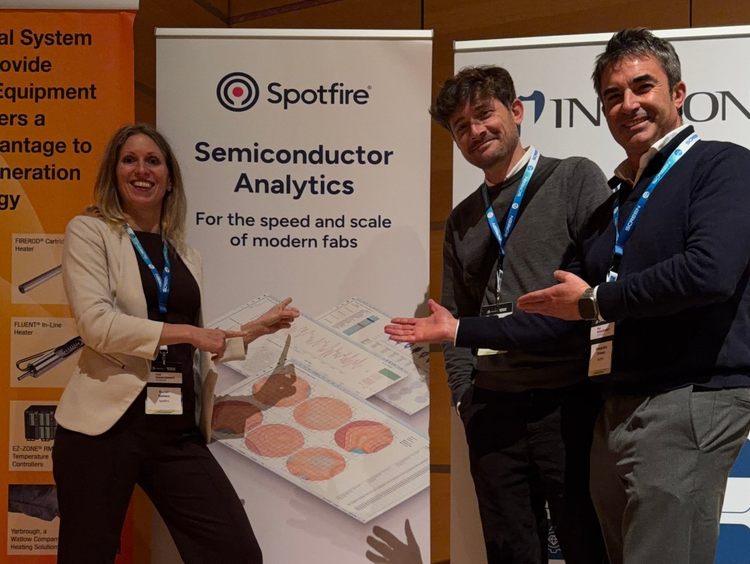
Eszter Kovacs, Arnaud Varin, and Alessandro Chimera at the Fab Management Forum, SEMICON Europa 2026, Munich.
Every hour between signal and cause has a wafer count
Start with a simple idea. In a modern fab, a process step runs around the clock, producing perhaps 25 wafers an hour in one chamber. If something drifts at midnight and the team only understands the cause at lunch, that is 300 wafers processed before the team fully understands the cause and knows which wafers are affected. Are they all bad? Probably not. But right now, nobody can say which ones are.
Automation did its job. It kept running. That is the point of it, and also the risk: the more a fab produces, the more wafers are exposed before anyone understands the problem.
And the data was there the whole time. The tool recorded it. Metrology saw it. Test confirmed it. But it sits in different systems, in islands, so a senior engineer has to put it together by hand, while the line keeps running, before the root cause can even be analyzed.
This blog post is about the speed of that resolution, and what AI can and should not do for it. Fabs will not all compete on volume. But the speed of trusted engineering decisions is not set by fab size or by country. It is set inside the fab, by how engineers work with data. That is something every fab can control, starting tomorrow.
Not what AI can do, but what it acts on
AI is already part of the fab. Prediction is established, with virtual metrology, equipment health and process behavior. Investigation is arriving now, with wafer patterns and candidate causes. Action, such as containment recommendations and governed automation, is emerging. So the question is no longer what AI can do. It is what AI acts on.
Integrated data, fragmented investigation
In the session we made a distinction that is easy to miss. A wafer has one process history, but that history is spread across wafer sort and final test, inline metrology, defect inspection, equipment and chamber signals, recipe, route and genealogy, and reliability and field returns. Decades of investment have made each of those easier to reach. But access to data is not the same as understanding it with connected, contextualized evidence. The data is integrated. The investigation is often not. And AI is now about to act on whatever evidence it is handed.
Plausible is not defensible
An AI finding such as "affected wafers are associated with Chamber Group B" sounds convincing. But a weak lead has a cost either way. If the team is slow, material stays exposed or on hold longer than it needs to. If the team is fast and wrong, good WIP is held, a healthy chamber goes down, and the real cause keeps running.
Containment itself is immediate: the hold rules fire as soon as the excursion is detected. The investigation that follows is what determines the real impact, what can be released, and which corrections are justified. So the goal is not the shortest time to a plausible answer. It is the shortest time to a defensible action. Before scope, disposition and corrective action are decided, four questions need answers. Are the cohorts comparable? Do process signals and history support the hypothesis? Which wafers were really exposed, and which can be released? What action does the evidence justify?
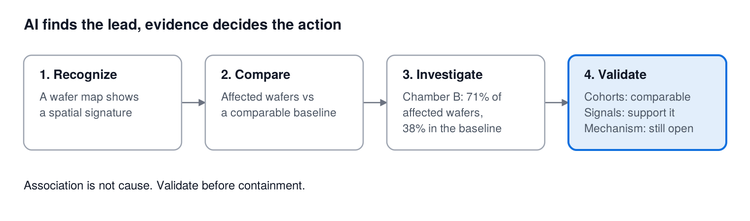
In our illustrative example, 71% of the affected wafers passed through chamber B, compared with 38% of a baseline population selected from the same product, route, and time windows. That difference makes chamber group B a promising lead, but association is not causation. Engineers still need to validate the supporting process evidence and investigate a plausible causal mechanism before deciding on corrective action. AI can speed up the lead, and evidence determines whether the lead supports an action.
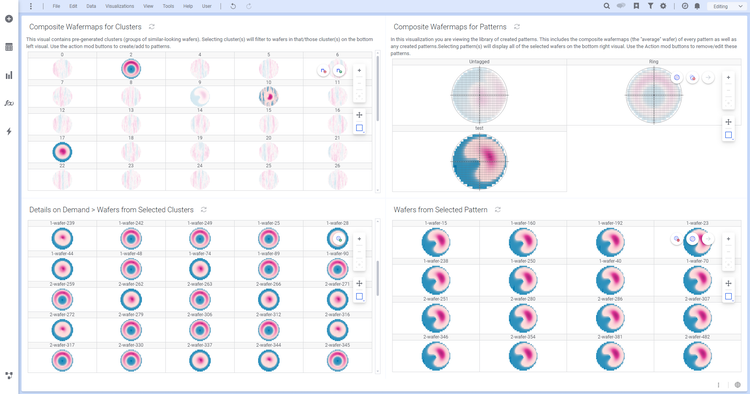
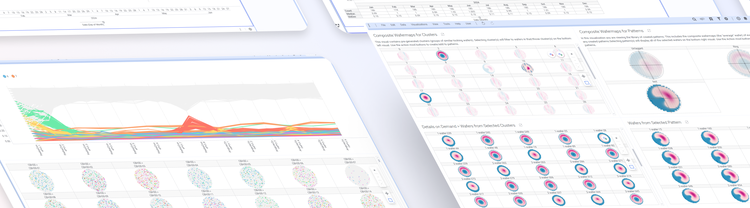
Composite wafer maps in Spotfire. Each pattern is a lead. The wafers, lots, and tools behind it are one click away.
Two loops, not one
Most talk about the autonomous fab is about the operations loop: sense, decide, execute, optimize. It is run by APC, scheduling and MES, and it is measured in output. But a fab needs a second loop for the unexpected. When an excursion leaves the line, it should be connected, explained and validated, and then kept as a method the next engineer can reuse.
Without that second loop, autonomy only speeds up what the fab already believes, mistakes included. AI contributes to both loops, and connected evidence links them.
In practice, every investigation should leave validated knowledge behind: an improved rule, model, recipe or response that the next engineer can start from, and not only a closed ticket.
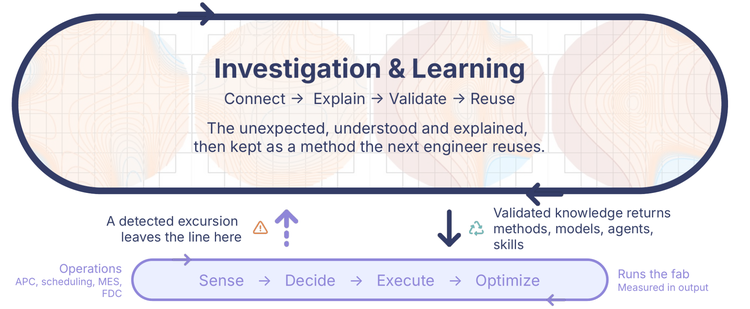
An excursion leaves the line. Validated knowledge comes back.
Where Spotfire fits
Spotfire is an industrial analytics environment built for this second loop, shaped with fabs and test houses. It is the place where the evidence from MES, FDC, APC and specialized fab systems meets, and where visualizations, statistics and AI work on the same traceable data. It rests on three things.
Connected context. Spotfire enables engineers to bring together wafer, lot, tool, chamber, recipe, route,time data, and explore their relationships through wafer-centric views, drill-downs, and linked visualizations. Rather than investigating each data domain separately, engineers connect the evidence within a shared analytical environment.
AI in the flow. Spotfire AI works inside the investigation, not in a chat box next to the charts. It recognizes wafer patterns, runs equipment commonality to rank which tools and chambers the affected wafers have in common, and compares populations statistically, so it proposes leads the engineer can examine and challenge. Reusable skills and agents package these steps so the next engineer starts from them.
Evidence and trust. Statistics an engineer applies without being a statistician, while keeping conclusions traceable to the population behind every suggestion, so a conclusion can be defended when someone asks why.
For a fab, that is what shortens the time from a first signal to a defensible action. And because the investigation lives in a shared environment rather than in one person's files, it becomes a workflow the next engineer starts from.
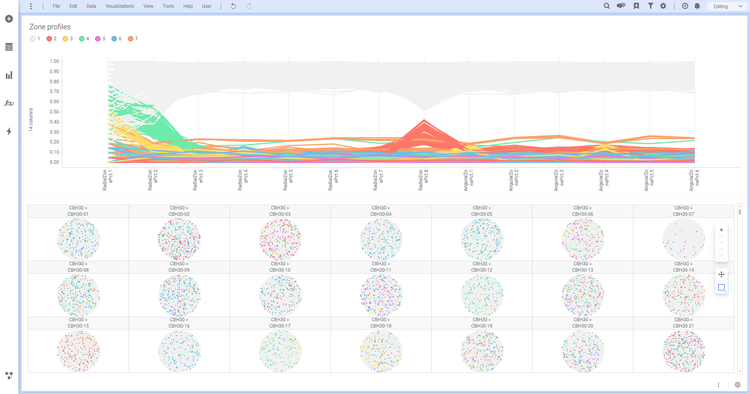
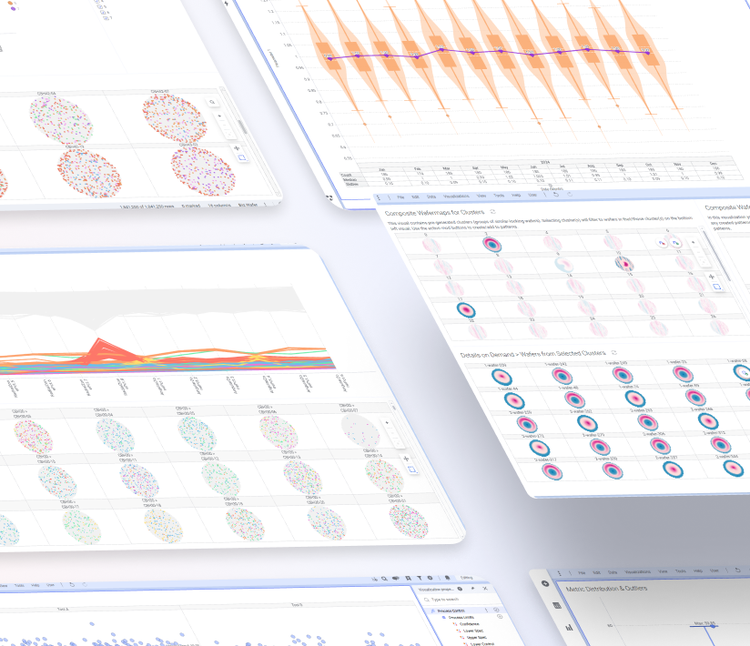
Zone profiles and linked wafer maps in Spotfire. Population comparison and the individual wafers stay in the same view.
The principle matters more than the product. Rather than replacing engineers, AI should augment their expertise with contextual analytics, domain-specific intelligence, and statistical guidance. That helps engineers ask better questions, move faster across data domains, spot patterns earlier, and decide with confidence, with human expertise staying at the center of manufacturing decisions.
Why this matters for every fab
Our key takeaway is simple: intelligent automation also needs connected, inspectable engineering evidence. The real value of the investigation above is not the hours saved on this investigation. It is the hours saved on the next one. A resilient fab does not just react faster. It learns faster. For a fab, learning faster from every excursion means three things.
Resilience. When something goes wrong, you have stronger evidence. You release what is good, and you hold only what you must.
Adaptability. Every exception becomes knowledge the next engineer can reuse, not just a closed ticket.
Competitiveness. Engineers spend their time improving the process, not rebuilding the context every single time.
Adaptability deserves a closer look. Many fabs face an engineer shortage, and a lot of experience will retire in the next few years. Today that experience often lives in one person's head, or in a folder full of Excel files. When that person leaves, the experience leaves with them. If the investigation lives on as a shared, reusable workflow, it stays in the fab. That is how a talent problem becomes a knowledge asset. What one engineer learns today, the whole fab knows tomorrow.
Most fabs clock time to detection and time to containment. Almost nobody measures how long it takes from the first signal to a defensible action: an action you can defend when someone asks why, whether that is your management, your quality team, or your customer. That clock stops when the team knows what to release, what to scrap, and what to correct. Measure it for every excursion. Look at the worst cases, not the average. Add it to your KPIs, next to cycle time and yield. And whatever AI you bring into your fab, judge it on one thing: does it shorten that number?
See how Spotfire® Industry Pro helps fab teams connect their engineering evidence and move from first signal to defensible action, or connect with a Spotfire expert to discuss what that could look like in your fab.