
From Fragmented Systems to Industrial Agility: The Rise of Industrial AI Analytics
Industrial teams don’t lack data; it’s just spread across systems. Historians, MES, EAM, and specialist engineering tools each hold part of the picture, but the answers to questions like “why did yield slip?” or “which asset is heading for trouble?” usually sit across several of those systems.
Getting from that disparate data to one decision is a time sink, but more importantly, an unmanaged risk. A new Verdantix Market Insight, From Fragmented Systems to Industrial Agility: The Rise of Industrial AI Analytics, provides some concrete details about the challenge. Based on a survey of 51 engineering and operations professionals across process manufacturing, oil and gas, utilities, and mining, metals, and minerals, the write-up shows what holds teams back and what leaders can do about it.
Why fragmentation slows decisions
Custom tools deliver proprietary methods but lack support
When off-the-shelf tools don’t reflect how a firm actually works, engineers build their own. Verdantix finds that in-house software supports between 35% and 55% of technical activities, including root-cause analysis, anomaly detection, and yield analysis. 64% of respondents have proprietary methods they want to standardize.
The intent is sound, because that software encodes hard-won know-how. But every in-house application has to be maintained, validated, and supported, often by engineers whose main job isn’t software development, and often after the original author has moved on. There is no roadmap and no support contract behind it.
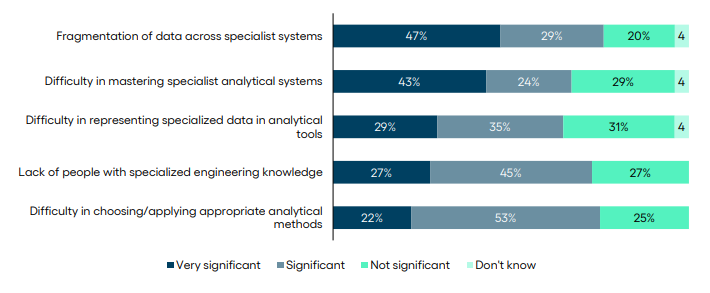
How significant are analytical problem-solving blockers across functions in your organization?
Source: Verdantix Industrial AI Analytics Survey 2026
Companies should not have to give up proprietary expertise to avoid carrying the maintenance burden alone.
Why industry-native capabilities and embedded AI matter
AI delivers the most value inside the analysis
Generic tools tend to miss how industrial experts work. 66% of respondents describe industry-native visualizations and algorithms as critical for success. The capabilities they say their teams use or want most include reliability and failure models (59%) and multivariate process control visualizations (53%).
The report is equally clear about AI. On its own, AI can return a plausible answer, but the answer arrives detached from the evidence, resting on improvised methods and confined to the session that produced it. Embedded in the analysis, AI works alongside the engineer. It draws on validated methods and industry-native views, scans more data than a person could, and suggests where to look next, while the engineer keeps the judgment.
What to do next
Connect the insight, not just the data
The report concludes that the answer isn’t more standalone tools. Verdantix recommends prioritizing a connected analytics decision layer that sits across existing systems, blends the technical data they hold, and lets teams ask questions across multiple disciplines and silos rather than being stuck in one.
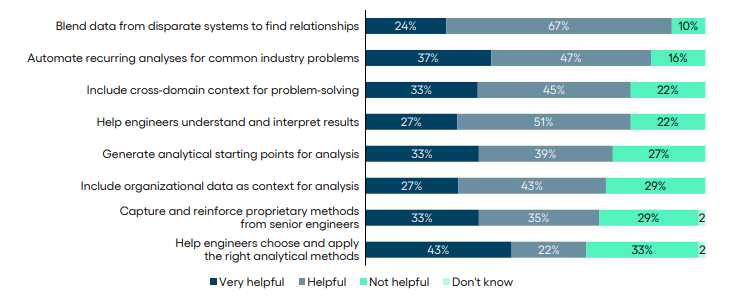
In what ways would industrial AI analytics most help your organization with problem-solving?
Source: Verdantix Industrial AI Analytics Survey 2026
Respondents point to where that helps most: 91% say blending data from disparate systems to find relationships would be helpful, and 84% say the same of automating recurring analyses for common industry problems.
Where Spotfire® fits
The Verdantix report highlights the need for a decision layer. That is what Spotfire is built to be.
One view across your systems, not another silo. Spotfire sits above your historian, MES, EAM, and enterprise sources and unifies the fragmented insights they produce into a single analysis. It augments your specialist tools and adds no new silo to integrate.
Industry-native analysis from day one, adaptable to your way of working. The capabilities respondents say their teams use or want, such as reliability analysis and process capability and control, are built into Spotfire® Industry Pro. Accelerators give teams a fast start and flexibility to incorporate their own methods.
Your methods, captured once and reused. Teams can capture their own calculations, engineering practices, and workflows as reusable applications that are shared, versioned, and governed centrally. Institutional knowledge is carried forward instead of living in one engineer’s spreadsheet or script.
Investigations that follow the evidence. Visualizations and computations stay live and linked. An engineer can mark an unusual group in one view and immediately ask what sets it apart, following the evidence across data sources.
AI-augmented investigation you can check and challenge. Spotfire AI, including Insight Agents, runs on the platform’s governed analytics and industry-native views, so results are reproducible, traceable, and open to challenge. Engineers can validate the evidence and stay in charge of the decision.
Looking ahead
Industrial agility, as Verdantix describes it, is the ability to detect disruption early and act with speed and precision. The findings suggest the path there runs through connecting the insight, expertise, and decisions that fragmented systems keep apart, so teams can protect uptime, operate safely, improve yield, and hold cost steady as conditions change.
Spotfire brings AI, advanced analytics, and industry expertise together in a single visual industrial analytics platform, with domain experts at the center of every decision.
Read the Verdantix Market Insight report to see the full survey findings, or connect with a Spotfire expert to discuss how a connected decision layer could work in your environment.